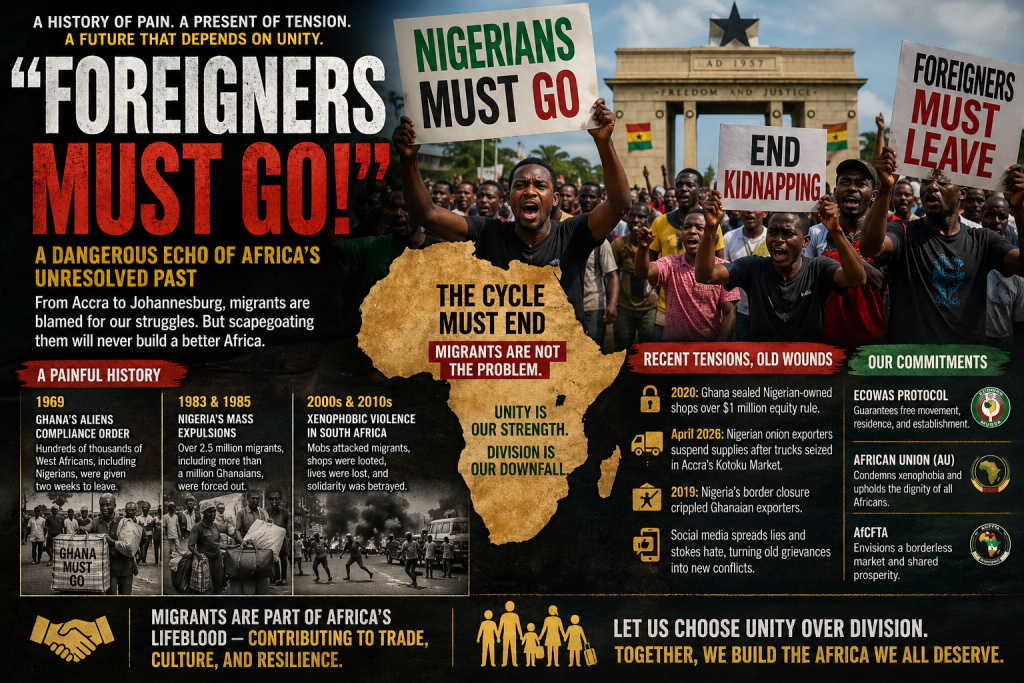
NIGERIA: The cry of “foreigners must go” is not a mere slogan — it is a dangerous echo of Africa’s unresolved past, a recurring wound that continues to bleed into the present. From Accra to Johannesburg, migrants have become the convenient scapegoats of economic hardship, insecurity, and populist politics.
What unfolded in Ghana in July 2025, when protesters carried placards demanding “Nigerians Must Go” and “End Kidnapping”, is not an isolated eruption of anger. It is the latest reminder that Africa’s fragile promise of unity remains under siege.
History is unrelenting in its lessons. In 1969, Ghana’s Aliens Compliance Order forced hundreds of thousands of West Africans — many of them Nigerians — to leave within two weeks. Though presented as a legal enforcement of immigration laws, it was driven by economic desperation and fears of foreign traders dominating local markets.
Nigeria’s retaliatory expulsions in 1983 and 1985, which drove out more than 2.5 million migrants, including over a million Ghanaians, were equally brutal. Families were torn apart, livelihoods destroyed, and regional trust poisoned. The humiliating exodus birthed the phrase “Ghana Must Go”, immortalised by the checked plastic bags migrants carried — a symbol of displacement and shame that still haunts the continent.
South Africa’s xenophobic violence in the 2000s and 2010s carried the same destructive energy. Mobs in Johannesburg and Durban attacked Zimbabweans, Mozambicans, Nigerians, and other migrants, chanting “foreigners must leave”. Shops were looted, lives lost, and the promise of pan-African solidarity betrayed. These attacks were not random — they were fuelled by unemployment, inequality, and leaders who found it easier to blame outsiders than to confront systemic failures.
Recent tensions in Ghana show how history continues to repeat itself. In 2020, authorities sealed Nigerian-owned shops for failing to meet a $1 million equity requirement. In April 2026, Nigerian onion exporters suspended supplies after trucks were seized in Accra’s Kotoku Market. Nigeria’s 2019 border closure, which crippled Ghanaian exporters, remains a sore point.
Social media has become a weapon in this conflict, spreading misinformation and inflating population figures to stoke resentment. A resurfaced 2013 video about an “Igbo Village” in Ghana was repurposed in 2025 to incite outrage, proving that in the digital age, old grievances can be reignited with a click.
Yet Africa is not without safeguards. Both Ghana and Nigeria are founding members of ECOWAS, which in 1979 adopted the Protocol on Free Movement of Persons, Residence, and Establishment. This guarantees citizens the right to live and work across borders.
The African Union (AU) has consistently condemned xenophobic attacks in South Africa and reminded states of their obligations under the African Continental Free Trade Area (AfCFTA), which envisions a borderless market and shared prosperity. These frameworks are not symbolic — they are binding commitments that, if enforced, could prevent the continent from sliding back into cycles of expulsions.
African leaders have intervened, though often reactively. In late 2025, Nigeria’s Minister of State for Foreign Affairs, Bianca Odumegwu-Ojukwu, travelled to Accra to secure assurances for Nigerian residents. ECOWAS has convened emergency meetings to address shop closures and border disputes. The AU has pressured South Africa to act against xenophobic violence.
These interventions matter, but they remain fragile, often overshadowed by domestic politics and populist pressures.
The truth is uncompromising: every expulsion, every attack, every chant of “must go” undermines Africa’s dream of unity. Migrants are not the cause of Africa’s economic woes — they are part of its lifeblood, contributing to trade, culture, and resilience. To scapegoat them is to weaken the very foundation of regional solidarity.
Unless governments confront unemployment, insecurity, and misinformation head-on, the cycle of hostility will continue.
The ghosts of 1969, 1983, and South Africa’s xenophobic flare-ups are not just historical memories — they are warnings. Today’s migrants live under the shadow of being told, once again, to pack their bags and leave.
If Africa is serious about integration, then leaders must enforce regional protocols with uncompromising resolve and remind their citizens that the continent’s strength lies not in division, but in unity. Otherwise, the fragile promise of African solidarity will remain unfinished, haunted by the recurring cry: “foreigners must go.”
For comments, reflections, and further conversation:
Email: samuelagogo4one@yahoo.com
Phone: +2348055847364