
NIGERIA– In a landmark judgment delivered on Wednesday, May 20, 2026, the Federal High Court in Abuja set aside key portions of the Independent National Electoral Commission’s (INrevised timetable for the 2027 general elections, holding that parts of the schedule were inconsistent with the provisions of the Electoral Act, 2026.
Hon. Justice M. G. Umar, ruling in a suit filed by the Youth Party against INEC (Suit No: FHC/ABJ/CS/517/2026), granted several declaratory reliefs and nullified INEC’s attempt to impose compressed timelines on political parties.
Key Rulings of the Court
Justice Umar held that:
- INEC cannot abridge the statutory 120-day period for the submission of candidates’ particulars under Section 29(1) of the Electoral Act, 2026.
- The Commission cannot shorten the 90-day period provided for the withdrawal and substitution of candidates under Section 31.
- INEC lacks the authority to publish the final list of candidates earlier than the mandatory minimum 60-day period stipulated under Section 32.
- INEC cannot dictate dates for party primaries, as its role is limited to monitoring such primaries rather than controlling the internal affairs of political parties.
- The requirement for the submission of membership registers 21 days before party primaries does not apply to substitution primaries conducted to replace withdrawn candidates. Consequently, political parties may submit fresh membership registers and permit new aspirants to participate in such primaries.
Boost to Democratic and Electoral Processes
Legal experts and political analysts have welcomed the judgment as a significant boost to Nigeria’s democratic and electoral processes. By reaffirming the supremacy of the Electoral Act over administrative guidelines issued by INEC, the court reinforced the principles of constitutionalism, the rule of law, and political party autonomy.
The ruling is expected to deepen internal party democracy by preventing the arbitrary compression of electoral timelines that could hinder genuine participation. Analysts say the decision restores the full statutory windows intended by the legislature, thereby promoting fairness, transparency, inclusiveness, and broader participation in the electoral process.
Relief for Opposition Parties and Aggrieved Aspirants
The judgment is widely regarded as particularly favourable to opposition and smaller political parties, many of which often operate without the financial resources and institutional advantages available to larger parties. With more flexible timelines now restored, such parties may have greater opportunity to reorganise, admit new members, conduct fresh substitution primaries, and field stronger candidates ahead of the 2027 general elections.
The decision also offers significant relief to aspirants who either withdrew from or lost earlier primaries. By allowing fresh membership registers and substitution processes closer to the election period, the ruling creates a practical opportunity for such politicians to join other parties and still secure nominations for the 2027 general elections, provided all actions remain within the bounds of the law.
Observers believe the judgment could encourage broader political participation, healthier political realignments, and a more competitive electoral environment ahead of the polls.
The Youth Party described the judgment as “a triumph for constitutional democracy and a victory for all genuine democrats in Nigeria.”
INEC has yet to issue an official statement on the ruling, although observers anticipate that the Commission may challenge the decision on appeal.
The certified true copy of the judgment, signed by Hon. Justice M. G. Umar, is expected to have far-reaching implications for political strategy, party primaries, and candidate selection ahead of the 2027 general elections.
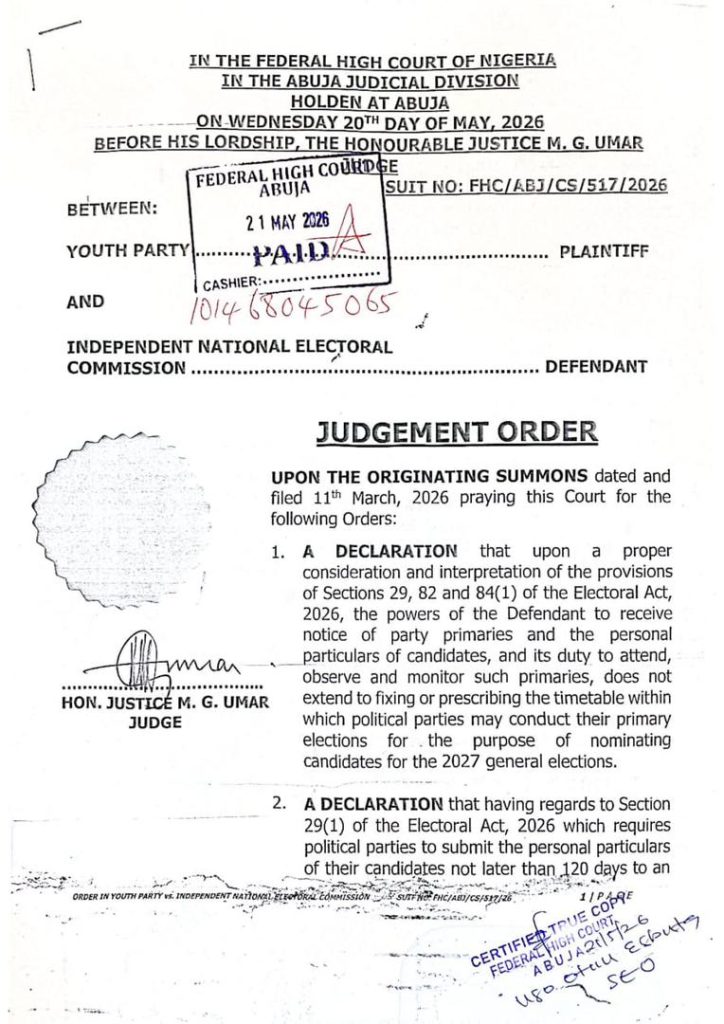
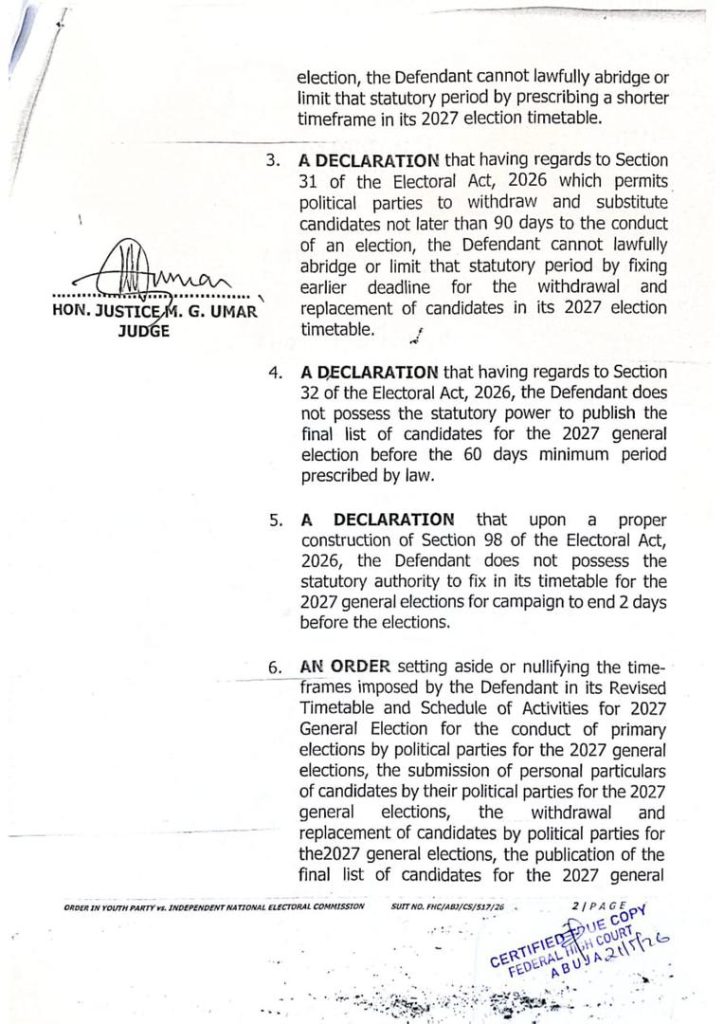
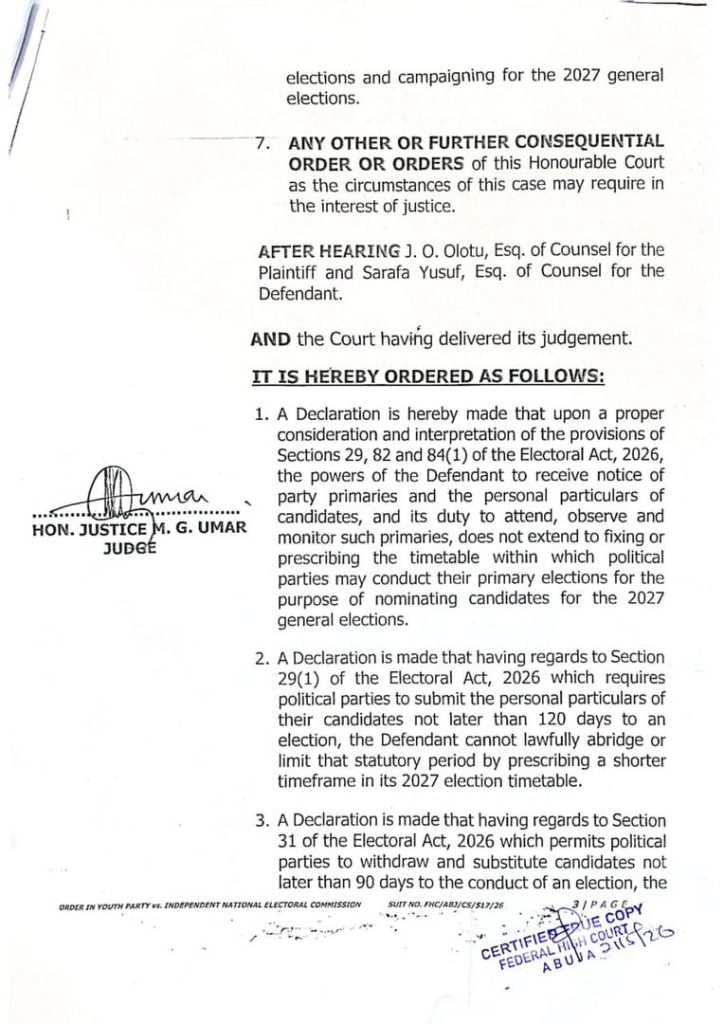
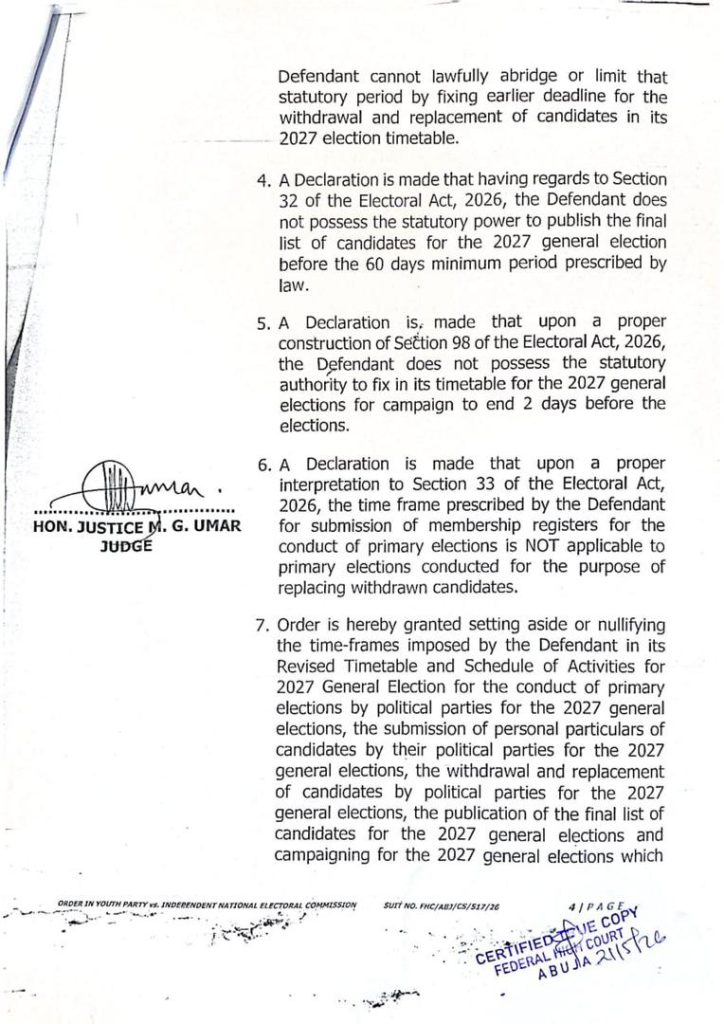
CTC of the judgement