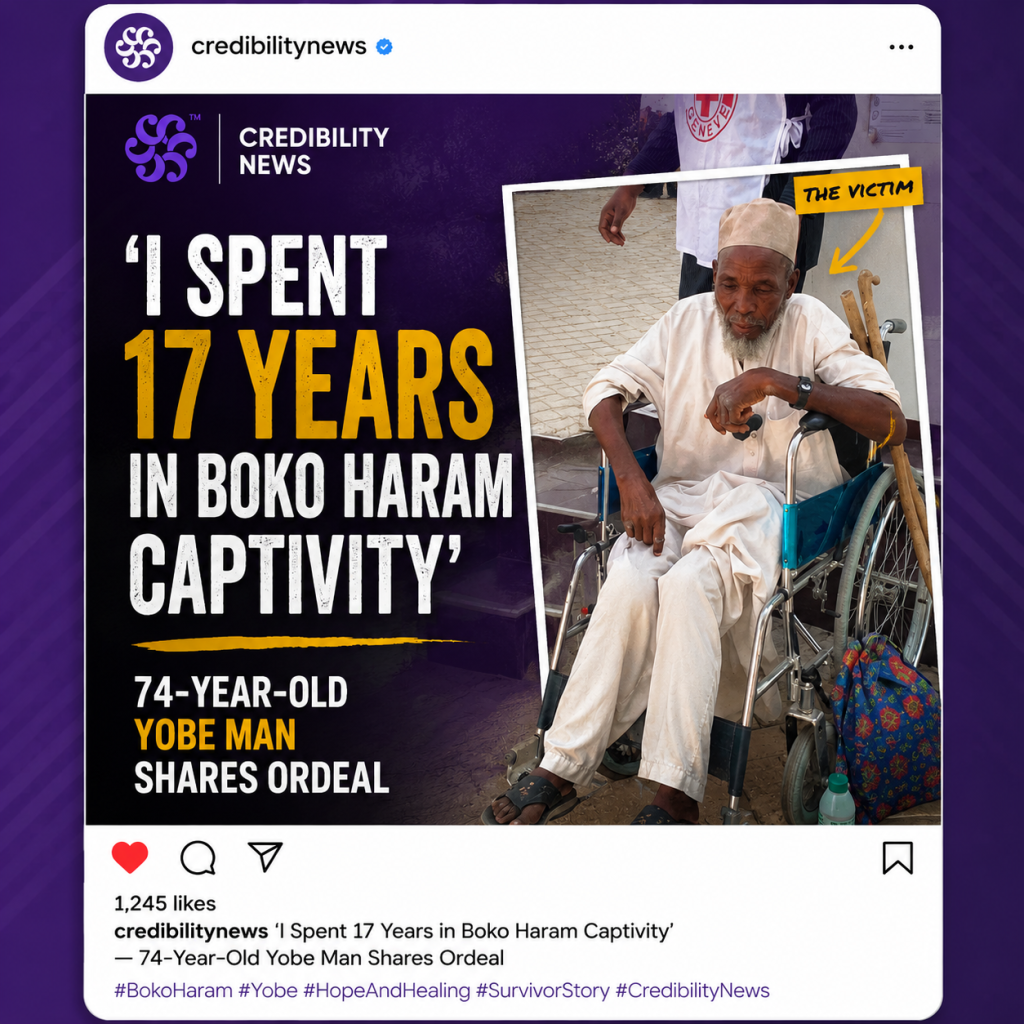
For nearly two decades, 74-year-old Audu Kadiri lived in uncertainty, cut off from his family and the outside world after becoming trapped in the Sambisa Forest, the notorious stronghold of Boko Haram insurgents.
Today, after years of separation, suffering, and unanswered questions, Kadiri has finally been reunited with a surviving relative through the efforts of the International Committee of the Red Cross (ICRC).
The emotional reunion came about 20 years after Kadiri left his hometown of Jaba village in Jakusko Local Government Area of Yobe State following a domestic misunderstanding that compelled him to seek better opportunities elsewhere. His journey, which began as a search for a better life, eventually turned into a nightmare that lasted 17 years in captivity among Boko Haram insurgents.
How It Began
Kadiri told The Credibility News that he first travelled to Lagos State, where he spent about a year trying to make a living.
“I left our home because of a domestic issue and misunderstanding with my family members. I cannot recall the exact year I left home, but I know it was during the administration of Bukar Abba Ibrahim.
“In a bid to calm the situation and improve my life, I decided to relocate to Lagos State in search of greener pastures,” he said.
According to him, after spending 12 months in Lagos, he decided to return to the North. However, instead of going back to his village, he travelled to Maiduguri in Borno State to continue searching for economic opportunities.
“I spent 12 months in Lagos and later packed my belongings to return home. But when I arrived in Damaturu, instead of returning to my village, I moved to Maiduguri because I still wanted to improve my life and make something meaningful out of it,” he said.
That decision would change the course of his life forever.
Trapped in the Forest
While in Borno State, Kadiri became involved in the collection of gum arabic, a common livelihood activity in parts of the North-East. It was during one of these expeditions that he found himself in the Sambisa Forest, where Boko Haram insurgents had established their stronghold.
He recalled that although the insurgent group emerged publicly in 2009 and initially operated mainly within Maiduguri, increasing military pressure later forced them into the vast forest.
“The Boko Haram insurgents appeared in 2009, but they were operating mainly in Maiduguri. It was the pressure from security agencies that forced them into the Sambisa Forest.
“When they started hiding in the forest, we were scouting for gum arabic. They took control of all directions within the forest and movement became impossible,” he narrated.
Kadiri explained that while he and several others were not formally abducted, they were prevented from leaving the area and effectively became captives.
“Although they did not abduct us in the way people normally understand abduction, they forced us to remain with them. We became shields against military operations.
“There was no way to escape. Anyone who attempted to flee would be killed. That was why I decided to remain there and endure the situation,” he said.
Life in Captivity
Life inside the forest, he said, revolved around survival.
According to him, the insurgents permitted some of the captives to engage in farming and harvest gum arabic, but they remained under strict control.
“They allowed me and my colleagues to farm and harvest gum arabic. We could sell the products either to them or to people they trusted.
“But they never allowed us to visit markets freely or leave the area. Any attempt to escape could result in death,” he said.
For 17 years, Kadiri remained trapped in the forest, surviving through farming and other menial activities while hoping for an opportunity to regain his freedom.
“We were held hostage for 17 years. I remained there farming and struggling to survive until military operations eventually led to my freedom.
“After my rescue, I was taken to the Gwoza Internally Displaced Persons (IDP) Camp, where I spent about three years before being reunited with my family,” he said.
The Toll of Captivity
However, freedom came at a terrible cost.
Years of hardship, illness, and restricted movement have left visible scars on his body. Today, Kadiri is confined to a wheelchair, his hands and legs severely swollen due to an illness he contracted while in captivity.
“I was infected by an unidentified illness in the Sambisa Forest. It caused severe swelling in my hands and legs.
“My body became weak because of years of hardship, sickness and immobility,” he said.
As painful as his years in captivity were, what troubles him most is the uncertainty surrounding his immediate family. When he left home, he was married with two young children.
“I left behind one wife and two children who were less than two years old at the time.
“I do not know where they are now because 20 years is not 20 months or weeks. It is a very long time.
“My prayer is to see my wife again before I leave this world,” he said emotionally.
Emotional Reunion
The reunion with his surviving relative was marked by tears, relief, and gratitude.
His uncle, Alhaji Na-Alkama, told our reporter that family members had almost given up hope of ever seeing Kadiri alive again.
According to him, the family was eventually traced through the intervention of the ICRC after Kadiri’s details were obtained from the Gwoza IDP camp.
“He left about 20 years ago in search of gum arabic and better opportunities. At the time, he left behind a wife and two children.
“I do not know the whereabouts of the wife because we are Fulani nomads and do not remain in one place for long.
“When he left, we were living in Bursali, but now we reside in Jaba village under Jakusko Local Government Area of Yobe State,” he said.
Na-Alkama explained that poverty and economic hardship often compelled families to send young men to other parts of the country in search of livelihoods.
“In families like ours, when parents do not have enough resources to cater for their households, they usually send their sons to other parts of the country to help improve family income.
“That was what forced him to leave home in search of greener pastures.
“After leaving Lagos, he returned to Borno State to engage in gum arabic activities. That was where he encountered Boko Haram members,” he said.
Expressing appreciation to the humanitarian organisation, he said the family remained grateful for the reunion.
“I am grateful to the ICRC for this intervention. When I return home, I will gather my people so that we can pray for this organisation that reunited us,” he said.
Heartbreaking Revelations
The Credibility News gathered that while Kadiri has finally reunited with his relatives after years of separation, the reunion also came with heartbreaking revelations.
His wife remains missing, while the two children he left behind have reportedly died. The elderly uncle who welcomed him back is now his only known surviving close family member.
ICRC’s Role
Speaking on the efforts that led to the reunion, the ICRC’s Protection and Family Links Team Leader in Damaturu, Mr Ishaku Luka, said Kadiri’s case was among the most challenging family tracing exercises undertaken by the organisation in Yobe State.
“This vulnerable adult had been separated from his family for more than 17 years.
“Our team registered his case and immediately began searching for relatives, particularly in Bursali area of Yobe State,” Luka said.
He explained that the nomadic lifestyle of the family complicated the tracing process.
“It was one of the most challenging tracing exercises we have handled because of the family’s constant movement from one location to another.
“Our teams had to travel extensively, spend nights in different communities and deploy personnel from Damaturu to several locations in search of leads,” he said.
Luka disclosed that thousands of families affected by insurgency in Yobe State are still searching for missing loved ones.
“In Yobe State alone, we have about 2,500 inquiries from people seeking information about missing family members.
“Currently, we are actively tracing approximately 2,000 individuals, many of whom disappeared as a result of the insurgency, particularly in Gujba Local Government Area and other affected communities,” he said.
For Kadiri, however, the reunion marks the end of a painful chapter and the beginning of another journey — one filled with hope, unanswered questions, and a final wish to find his missing wife before the end of his life.
After 17 years in captivity and two decades away from home, he has finally found his way back.