The International Olympic Committee (IOC) has announced a new policy barring transgender athletes from competing in female category events at the Olympics, a decision its president says is grounded in science and aimed at ensuring fair competition.
Under the new rules, only biological female athletes will be eligible to compete in women’s events. Screening will be conducted via saliva, cheek swab, or blood sample — methods the IOC described as unintrusive compared to alternatives — and will be carried out only once in an athlete’s career.
IOC President Defends Decision
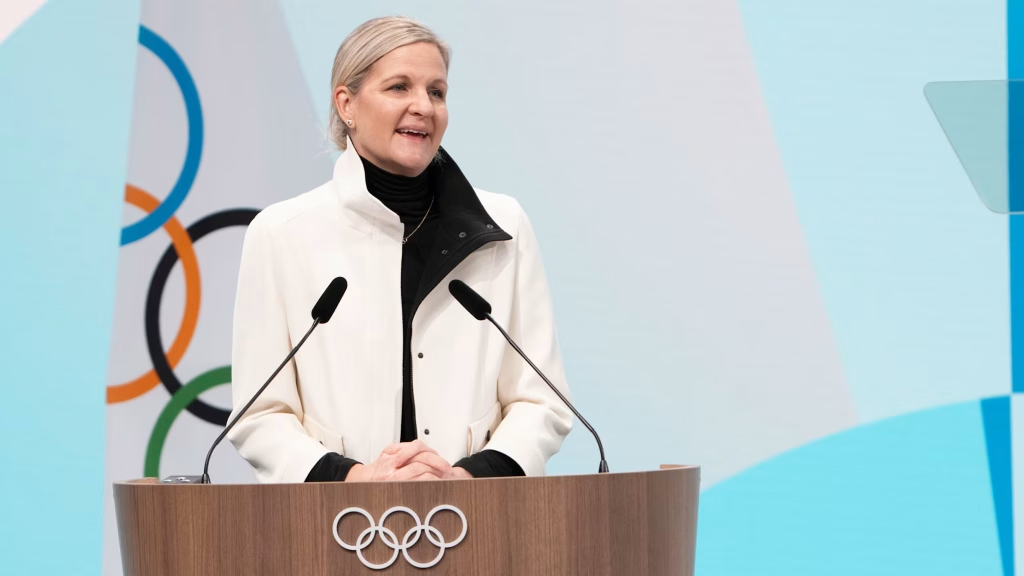
IOC President Kirsty Coventry defended the policy during a press conference on Thursday, emphasising that it was developed with athlete welfare as the priority.
“I really believe that this policy is foundationally based in science and it’s been led by medical experts, and it’s been done with the best interests of athletes right at the heart,” Coventry said.
She acknowledged the sensitivity of the issue but expressed confidence that the policy strikes a balance.
“We hope that you’ve all seen the policy and we hope that you can read the policy knowing and understanding that we have taken into consideration all of our stakeholders from around the world, all the multiple views and been able to put together a policy that we can stand firmly behind with the emphasis of ensuring that athletes are looked after, that athletes have the ability to compete on a fair and level playing field, and I believe that’s what we have done.”
New Testing Protocol
The policy introduces screening for the SRY gene — the sex-determining region Y gene — which is typically present only in males. The testing will be conducted once per athlete and is designed to establish eligibility for female category events.
The IOC’s move comes amid a broader global debate over transgender participation in women’s sports, with sporting bodies, governments, and human rights organisations deeply divided.
Historical Context and Political Pressure
Only a handful of openly transgender athletes have competed in the Olympics. New Zealand weightlifter Laurel Hubbard became the first to do so when she competed in the Tokyo 2020 Games (held in 2021).
The IOC’s announcement also follows significant political pressure, particularly from the United States. President Donald Trump signed an executive order in February 2025 titled “Keeping Men Out of Women’s Sports,” banning transgender athletes from competing in female categories in school, college, and professional events across the country.
Trump has also stated he would not allow transgender athletes to compete at the 2028 Los Angeles Olympics, raising questions about how the IOC’s new policy will align with US federal requirements.
Controversy and Opposition
Before the IOC’s announcement, human rights and sports advocacy groups voiced strong opposition to gender testing measures, arguing they could be intrusive, discriminatory, and harmful to transgender athletes. Critics also note that such policies can disproportionately affect athletes with differences in sex development (DSD) and may not reflect the diversity of human biology.
Supporters of the policy, however, argue it is necessary to protect the integrity of women’s sports and ensure fair competition.
What Happens Next
The policy will take effect for future Olympic Games, including the Milan-Cortina Winter Olympics in 2026 and the Los Angeles Summer Olympics in 2028. How it will be implemented alongside varying national laws — particularly in the United States — remains an open question.
For transgender athletes hoping to compete at the elite level, the decision represents a significant barrier, narrowing the path to inclusion in international sport.
Based on reporting by Reuters. Additional analysis by The Credibility News