Tensions between the United States and its NATO allies have flared after President Donald Trump said he was considering pulling America out of the Western military alliance, citing European members’ refusal to send ships to help unblock the Strait of Hormuz.
NATO — which includes European nations, the United States, and Canada — was formed in 1949 to counter the threat of Soviet attack and has remained the cornerstone of Western security ever since.
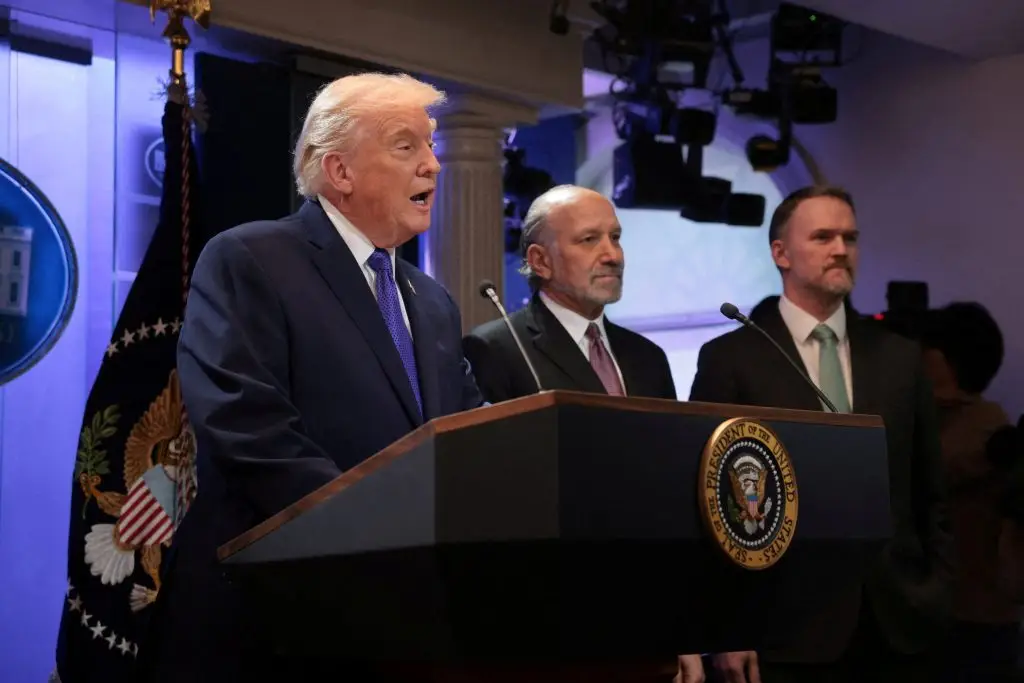
Trump told Reuters on Wednesday that he would state in an address to the nation later that he was “absolutely” considering withdrawing the United States from the alliance.
“I’ll be discussing my disgust with NATO,” he said. Asked whether he was thinking of pulling out, he replied: “Oh, absolutely without question. Wouldn’t you do that if you were me?”
His remarks came just hours after his Defence Secretary, Pete Hegseth, declined to reaffirm the U.S. commitment to NATO’s collective defence — a principle that lies at the heart of the alliance. Experts say it is unclear whether Trump could act unilaterally to leave the 77‑year‑old coalition, even though he frequently makes major decisions without congressional approval.
Concerns Over Collective Defence
Analysts have warned that Trump’s repeated suggestions that the United States might not honour its NATO commitments could encourage Russia to test the alliance’s readiness to enforce Article 5, which states that an armed attack against one member is an attack against all.
France was among the first European NATO members to react to similar comments Trump made to Britain’s Daily Telegraph, in which he called NATO a “paper tiger” and said he was considering exiting after allies failed to back U.S. military action against Iran.
“Let me recall what NATO is,” French junior army minister Alice Rufo said, without directly addressing Trump’s threat to leave. “It is a military alliance concerned with the security of territories in the Euro-Atlantic area. It is not intended to carry out an operation in the Strait of Hormuz, which is not in accordance with international law.”
Finnish President Alexander Stubb told Trump in a phone call that a “more European NATO” was taking shape and that Europe was shouldering more responsibility, his office said.
Julianne Smith, who served as former President Joe Biden’s ambassador to NATO, said Europe was already spending heavily on its own defence but would need “probably the better part of a decade before they can really take on all of the roles and responsibilities that the United States is currently providing to the alliance.”
“There are limits because they cannot just snap their fingers and secure capabilities like air-to-air refuelling or lift or intelligence surveillance and reconnaissance overnight,” said Smith, now a non‑resident fellow at the Chicago Council on Global Affairs.
Calls for Calm
In Poland, Defence Minister Władysław Kosiniak-Kamysz called for calm.
“I hope that amid the emotions surrounding the President of the United States today, a moment of calm will come,” he said. “Because there is no NATO without the United States, and it is in our interest that this calm comes. But there is also no American power without NATO.”
NATO had no immediate comment.
A German government spokesperson, asked about Trump’s remarks during a press conference, said Germany remained committed to NATO. “This isn’t the first time he’s done this, and since it’s a recurring phenomenon, you can probably judge the consequences for yourself,” they said.
British Prime Minister Keir Starmer said he would act in his country’s interest, whatever the “noise”. The instability caused by the Iran war meant Britain should pivot to closer economic and defence ties with Europe, he added.
Iran War Widens Rift
The Iran war has exacerbated tensions between the United States and Europe that have been building since the start of Trump’s second term over issues ranging from trade to Ukraine and his demands for control of Greenland, an autonomous territory of NATO ally Denmark.
Trump threatened to stop supplying weapons that Europe has been buying for Ukraine unless European allies joined a “coalition of the willing” to reopen the Strait of Hormuz, the Financial Times reported.
Asked on Tuesday whether the United States was still committed to NATO’s collective defence, Hegseth said: “As far as NATO is concerned, that’s a decision that will be left to the president. But I’ll just say a lot has been laid bare.”
“You don’t have much of an alliance if you have countries that are not willing to stand with you when you need them,” he added.
France has refused to allow Israel to use its airspace to resupply a flight carrying American weapons for the war against Iran, and Italy denied permission for U.S. military aircraft to land at the Sigonella air base in Sicily before heading to the Middle East, sources told Reuters. Both countries said it was standard policy and nothing had changed.
Spain, however, said publicly it had fully closed its airspace to U.S. planes involved in attacks on Iran.
Trump has also repeatedly criticised Britain for not joining the United States when it launched the war.
Based on reporting by John Irish and Steve Holland for Reuters. Additional analysis by The Credibility News.