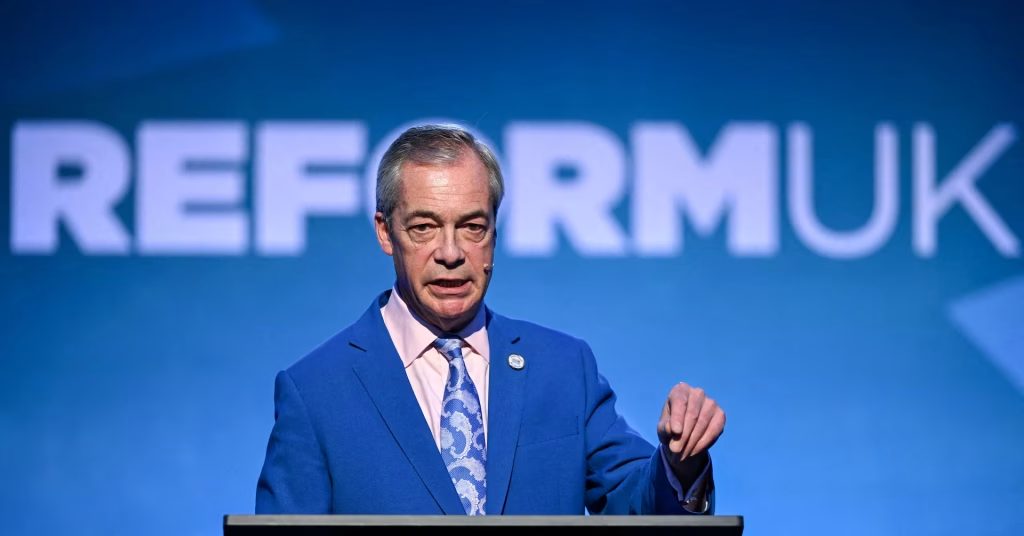
Reform UK leader Nigel Farage has pledged to block visa requests from any country demanding slavery reparations from the United Kingdom, the party’s home affairs spokesman has confirmed.
Zia Yusuf, unveiled last month as Reform UK’s immigration chief (and currently serving as the party’s home affairs spokesman), argued that countries pushing for £18 trillion in repayments are ignoring the “huge sacrifices” Britain made to ban and suppress the barbaric transatlantic slave trade.
The £18 trillion figure originates from a 2023 advisory report by UN Judge Patrick Robinson, which estimated the potential scale of reparations owed by former colonial powers, including the UK, for its historical role in the slave trade. The claim gained renewed prominence following the recent UN resolution urging reparatory justice.
Nigeria and Jamaica have been prominent in the reparations campaign. If Reform wins the next general election, nationals from these and other demanding nations could face visa bans from Britain.
‘Enough Is Enough’
Yusuf said: “A growing number of countries are demanding reparations from Britain. They ignore the fact that Britain made huge sacrifices to be the first major power to outlaw slavery and then enforce that prohibition internationally.
“Astonishingly, over the past two decades, Tory and Labour governments issued 3.8 million visas to nationals of these countries and provided them with a staggering £6.6 billion in foreign aid. Enough is enough.”
Nigel Farage has been equally vocal on the issue. Reacting to the UN’s push, he told GB News: “Forget it. The U.N. has no legitimacy over this country whatsoever.” He added that Britain was being told it “should go bankrupt, to apologise for what people did in 1775 or whatever it might have been,” describing the demands as the country being “kicked in the teeth repeatedly by the United Nations, treated abusively.”
Farage has also stated: “I’ve had enough of us being threatened by the UN and these countries. It’s time to make a stand.”
Historical Context
Between 1640 and 1807, British ships played a dominant role in the transatlantic slave trade, transporting an estimated 3.4 million enslaved Africans across the Atlantic. This accounted for a significant share of the overall trade, in which roughly 12 million Africans were forcibly removed from their homelands.
Britain’s position later shifted dramatically. After abolishing the slave trade in 1807, the Royal Navy’s West Africa Squadron worked to suppress it, capturing around 1,600 slave ships and freeing approximately 150,000 enslaved Africans by 1860 — an effort that cost the lives of nearly 2,000 British sailors.
The United Kingdom formally abolished slavery across most of its empire with the Slavery Abolition Act of 1833. France followed with definitive abolition in 1848, and the United States ended legal slavery in 1865 after the Civil War.
In recent decades, several former British colonies — including Barbados, Jamaica, and Kenya — have called for reparations from the UK, citing the long-term economic and social legacies of slavery and colonial rule. These claims remain highly contentious.
A parallel debate concerns cultural heritage. Numerous African artefacts, particularly from Nigeria, Ghana, and the former Kingdom of Benin, are held in European museums, including major institutions in the United Kingdom. Many of these objects were not acquired through legitimate purchase or voluntary exchange. Instead, significant numbers — most notably the renowned Benin Bronzes — were stolen during colonial military expeditions. A prominent example is the 1897 British Punitive Expedition against Benin City, during which British forces looted thousands of brass, bronze, and ivory artworks from the royal palace and shrines, burned much of the city, and dispersed the treasures. Many were subsequently sold at auction or transferred to museums in Britain and elsewhere.
These artefacts have generated scholarly interest, exhibitions, and revenue for the institutions holding them. However, their presence in UK collections is increasingly viewed as the direct result of theft and colonial violence rather than fair acquisition. Some progress on restitution has been made. The University of Oxford has identified over 140 looted Benin artefacts and moved toward their return to Nigeria. The University of Cambridge has transferred legal ownership of 116 Benin artefacts to Nigeria’s National Commission for Museums and Monuments. In certain cases, private descendants of those involved in the expeditions have also voluntarily returned items.
However, Reform UK’s proposal to block visas for nationals of countries demanding slavery reparations (including Nigeria, Ghana, Kenya, and several Caribbean nations) is flawed and likely counterproductive. Many of the cultural objects at the heart of these disputes were not lawfully acquired by the United Kingdom; they were looted and taken by force during colonial conflicts. Threatening punitive measures in response to reparations or repatriation demands risks inflaming diplomatic tensions rather than resolving the underlying ethical and historical issues.
A more constructive path would involve transparent, case-by-case examination of provenance, acknowledgment of how these objects were taken, and collaborative agreements that respect both Britain’s complex historical record — its central role in the slave trade alongside its later efforts to suppress it — and the legitimate claims of source communities.
UN Resolution
In March 2026, the United Nations General Assembly adopted a resolution declaring the transatlantic slave trade and racialised chattel enslavement “the gravest crime against humanity” and urging former colonial powers to pay reparations. The UK was among 52 countries that abstained on the non-binding resolution, which was spearheaded by Ghana and passed with 123 votes in favour.