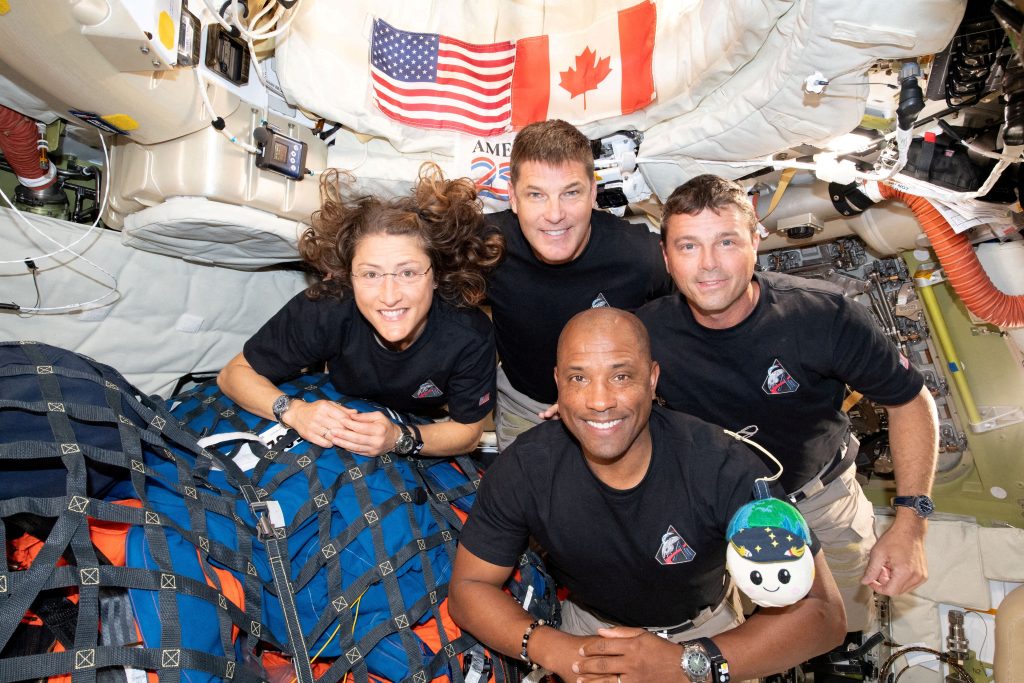
The Artemis II capsule and its four-member crew splashed down safely in the Pacific Ocean on Friday, ending a nearly 10-day voyage that took humans farther from Earth than anyone has flown in more than 50 years.
While the mission was led by NASA, UK scientists and European partners played key roles — including building critical components of the Orion spacecraft’s service module. For British readers watching the space race heat up, this mission signals that Europe is no longer merely a spectator.
NASA’s Orion capsule, named Integrity by the crew, parachuted into calm seas off the Southern California coast at 5:07pm Pacific Time (1:07am Saturday BST).
The crew — Americans Reid Wiseman (commander, 50), Victor Glover (pilot, 49), Christina Koch (mission specialist, 47) and Canadian Jeremy Hansen (mission specialist, 50) — travelled more than 252,756 miles from Earth, breaking the record set by Apollo 13 in 1970.
“A perfect bull’s-eye splashdown,” NASA commentator Rob Navias said during the live webcast.
“We are stable one — four green crew members,” mission commander Reid Wiseman radioed just after splashdown, confirming the capsule was upright and all astronauts were in good health.
The most dangerous part of any Moon mission is neither the launch nor the landing — it is re-entry.
The capsule plunged into Earth’s atmosphere at around 32 times the speed of sound. Atmospheric friction heated its heat shield to roughly 5,000°F (2,760°C).
A sheath of ionised gas enveloped the vehicle, causing a planned radio blackout lasting more than six minutes. Communication returned about 40 seconds later than expected — a brief delay that heightened tension at mission control.
The heat shield on Artemis II was a redesigned version. During the uncrewed Artemis I test in 2022, the shield suffered unexpected charring and stress. Engineers adjusted the descent trajectory for Artemis II to better protect the crew.
That success brings NASA one step closer to landing humans on the Moon again — safely.
Why the UK and Europe should care
While Artemis II was a NASA-led mission, the UK and Europe are deeply involved in what comes next.
British companies contributed key technology to the Orion spacecraft, including elements of its power systems and software.
The European Service Module, built by Airbus in Germany with UK components, provides the astronauts with power, water, oxygen and temperature control.
Future UK astronauts: The European Space Agency (ESA), of which the UK is a member, has already selected new astronauts for upcoming missions. A British astronaut could fly around the Moon before 2030.
Unlike the Apollo era, when only Americans walked on the Moon, Artemis is an international programme. The UK is contributing financially — and British science is benefiting directly.
The mission unfolded against a turbulent political backdrop in the United States. President Donald Trump congratulated the crew, calling the trip “spectacular.”
However, NASA has faced significant workforce reductions — around 20% — as part of federal downsizing efforts. The White House has also proposed cutting $3.4bn from the agency’s science budget.
For context, the UK Space Agency’s annual budget is roughly £500 million. The proposed US cuts exceed five times that entire budget, with potential implications for global space research partnerships.
NASA’s next step is Artemis III, planned for 2027 or 2028, which aims to land astronauts on the lunar surface — the first time since Apollo 17 in 1972.
China is targeting a crewed Moon landing around 2030. The new space race is firmly under way.
“Guess we’ll have to go back,” mission control told the Artemis II crew as they approached Earth.
That is exactly the plan.
Artemis II has proved that humans can safely travel to the vicinity of the Moon and return. For the UK, it confirmed that British and European space technology is reliable and ready. And for anyone wondering whether space exploration still matters — more than three million people watched the splashdown live on YouTube alone.
Sources: Reuters, NASA, UK Space Agency, European Space Agency