Four astronauts have safely returned to Earth after completing the first crewed voyage to the vicinity of the Moon in more than half a century.
The Artemis II crew streaked through Earth’s atmosphere and splashed down in the Pacific Ocean on Friday, capping a nearly 10-day mission that took humans farther from Earth than anyone has travelled since the Apollo era.
The four-person crew — US astronauts Reid Wiseman (commander), Victor Glover (pilot) and Christina Koch (mission specialist), along with Canadian astronaut Jeremy Hansen — executed a series of critical final manoeuvres to ensure a precise re-entry and safe splashdown.
According to Reuters, the Orion spacecraft hurtled back toward Earth on Friday as the crew prepared for the final phase of descent. By Friday afternoon, the autonomously piloted capsule performed an eight-second firing of its jet thrusters to fine-tune its flight path — one of several course-correction burns essential for a safe return.
The NASA mission culminated with the gumdrop-shaped Orion vehicle jettisoning its service module, followed by a high-speed re-entry through Earth’s atmosphere, a planned radio blackout caused by ionised plasma, and parachute deployment before splashing down in the ocean.
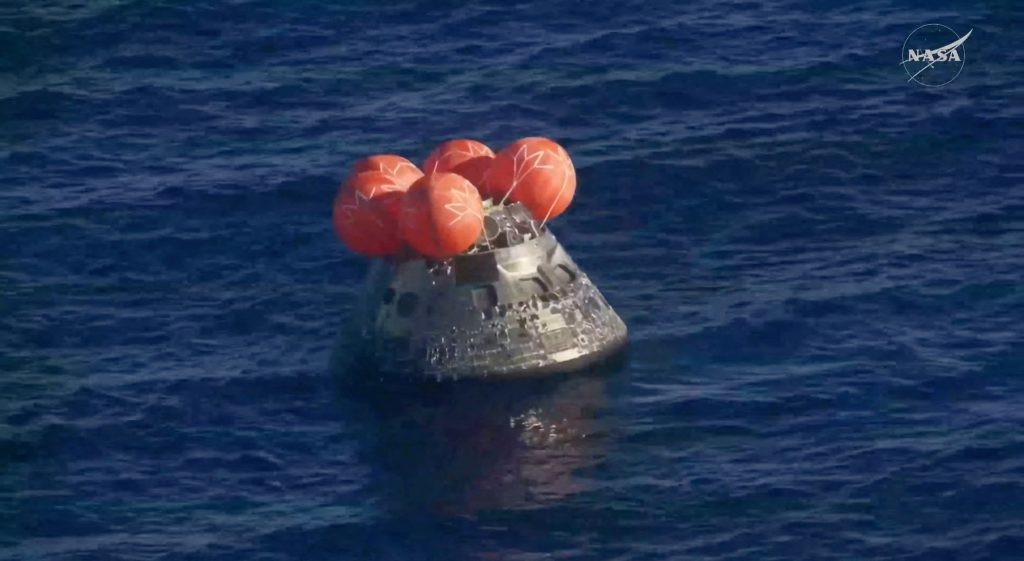
The astronauts are now safely aboard their Orion capsule, named Integrity, bobbing in the Pacific off the coast of San Diego, California. Splashdown occurred at approximately 5:07pm Pacific Time (8:07pm Eastern Time / 0007 GMT Saturday).
The quartet launched from Cape Canaveral, Florida, on April 1 aboard NASA’s giant Space Launch System (SLS) rocket. They entered Earth orbit before looping around the far side of the Moon, venturing deeper into space than any humans in more than 50 years.
This mission marked the first time astronauts have flown in the vicinity of the Moon since the Apollo programme of the 1960s and 1970s. Glover, Koch and Hansen also made history as the first Black astronaut, the first woman, and the first non-American, respectively, to participate in a lunar mission.
Following the uncrewed Artemis I test flight in 2022, Artemis II served as a critical dress rehearsal for Artemis III — planned for later this decade — which aims to land astronauts on the lunar surface for the first time since Apollo 17 in 1972.
The ultimate goal of the Artemis programme is to establish a long-term human presence on the Moon as a stepping stone to eventual crewed missions to Mars.
During the final 24 hours of the mission, the crew stowed equipment and configured the cabin for re-entry and splashdown.
The return placed the Lockheed Martin-built Orion spacecraft through a vital test of its heat shield, which experienced unexpected charring and stress during the 2022 uncrewed flight. NASA engineers therefore adjusted the descent trajectory for Artemis II to reduce heat buildup and lower the risk to the crew.
Even with the modified path, Orion plunged into the atmosphere at approximately 24,000 miles per hour (38,625 km/h) — about 32 times the speed of sound — with external temperatures expected to reach as high as 5,000°F (2,760°C).
As is typical during such returns, the intense heat and air compression created a sheath of ionised gas (plasma) around the capsule, temporarily cutting off radio communication. Two sets of parachutes then deployed to slow the descent to about 17 mph (27 km/h) before the gentle ocean landing.
The final thruster burns, including one roughly five hours before splashdown and a last adjustment near the top of the atmosphere, were critical for achieving the precise re-entry angle.
Once the capsule entered the upper atmosphere, the sequence from plasma blackout to parachute deployment took less than 15 minutes. NASA expected recovery teams to secure the capsule, assist the astronauts out one by one, and hoist them into helicopters within about an hour of splashdown.
At the mission’s peak, the crew reached a record distance of 252,756 miles from Earth, surpassing the previous mark of roughly 248,000 miles set by Apollo 13 in 1970.
The successful launch of the SLS rocket also provided long-awaited validation for Boeing and Northrop Grumman, confirming that the system — more than a decade in development — is ready to carry humans into deep space.
A Question for African Leaders
As the world celebrates this milestone in human exploration, many in Africa are left wondering whether their leaders would choose to invest public funds in meaningful space-related initiatives — such as satellite technology for agriculture, climate monitoring, security and disaster management — rather than diverting resources for personal gain.
Nigeria and Rwanda have already taken symbolic steps by becoming the first African nations to sign the Artemis Accords, signalling interest in responsible space cooperation. South Africa has provided practical support to the Artemis II mission through its ground stations.
However, with widespread challenges of corruption, poverty, and underfunded basic services across much of the continent, the Artemis programme raises a deeper question: Can African leaders prioritise visionary, long-term investments in science and technology that benefit their citizens, or will short-term selfish interests continue to prevail? True progress may depend on choosing the former — investing in the stars while building stronger foundations on Earth.
This mission represents a major milestone in NASA’s Artemis programme and international efforts to return humans to the Moon.
Sources: Reuters, NASA, UK Space Agency, European Space Agency, additional reporting on African space initiatives