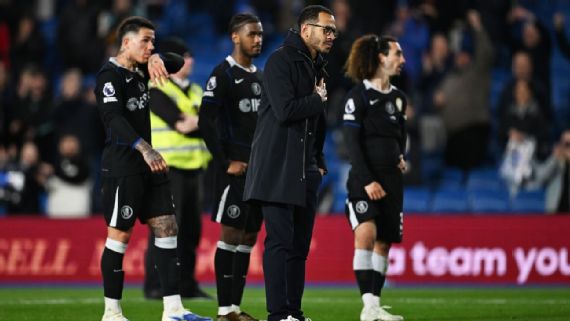
The latest setback, a comprehensive 3–0 loss to Brighton & Hove Albion, was perhaps the clearest indication yet of a team struggling for identity and confidence. Goals from Ferdi Kadioglu, Jack Hinshelwood, and Danny Welbeck sealed a dominant victory for Brighton, but beyond the scoreline, it was the manner of Chelsea’s performance that has raised the most alarm.
From kickoff, Chelsea appeared disconnected and uncertain. Brighton dictated the intensity of the match with composure and clarity, while Chelsea struggled to impose themselves in any meaningful way. Their build-up play was slow and predictable, allowing Brighton to maintain defensive shape and win the ball back with ease.
Despite enjoying spells of possession, Chelsea failed to translate that control into big chances. Their forwards were often isolated, with little support from midfield, and the final ball consistently lacked precision. This stagnant attack has contributed most to their recent form.
Defensively, the problems were equally glaring. Poor positioning, lack of communication, no leadership quality from the defensive backline, and an inability to deal with transitions left Chelsea exposed. Brighton exploited these weaknesses effectively, capitalising on space and punishing mistakes with clinical finishing.
Just like the four previous losses — to Newcastle United, Everton, Manchester City, and Manchester United — the Blues failed to score a single goal. For the first time since 1912, Chelsea have lost five consecutive league games without scoring. Chelsea have secured only one win in their last eight games in all competitions, suffering seven losses.
Chelsea currently sit in seventh position with 48 points, seven points behind fifth-placed Liverpool in the fight for a top-five finish that guarantees Champions League qualification. This is a hard time for both the club and the fans, considering the valuation of Chelsea’s squad depth.
For a club like Chelsea — which has tasted victory in all levels of competition, won all major trophies, and became the first club to win the newly introduced Club World Cup — this run of form is a bitter pill to swallow.
Tactically, most players in the first team are suffering from a loss of form, including Cole Palmer and Pedro Neto, while others are inconsistent due to injury. Chelsea’s defensive line has been repeatedly exposed, particularly during quick transitions. A lack of coordination and awareness has made it easy for opponents to exploit gaps, leading to avoidable goals.
Most importantly, the approach of co-owners Todd Boehly and Behdad Eghbali — signing mostly young talent — has led to a squad that often becomes average or less. Under such an ideology, there is a whole lot of uncertainty, while Chelsea as a club and its fans are used to winning.
This reflects the days of Roman Abramovich, but the new owners have a different ideology entirely. Many of these players lack experience in big games. The backline has no proper pairing due to injury, and there is a lack of experienced defenders to serve as leaders.
The midfield has struggled to strike the right balance between defensive duty and creative output. At times, it has been too passive, allowing opponents to dominate possession, which leads to a lack of creativity — no progressive or diagonal passes, no true assist-worthy deliveries. The team’s attacking structure appears fragmented. There is little movement between the lines, and players often occupy the same spaces, reducing passing options. Without a clear attacking pattern, Chelsea relies heavily on individual moments of brilliance — something that has been in short supply during this losing streak.
During the loss at Brighton, Chelsea fans jeered at manager Liam Rosenior and his players, chanting: “We want our Chelsea back.” It is a painful situation for a team that cost in excess of $1 billion to assemble and now faces the likelihood of missing out on the lucrative Champions League.
Chelsea supporters have begun to voice their dissatisfaction as the losing run continues. Expectations at the club remain high, and the current performances fall well below the standards associated with Chelsea’s recent history.
When asked whether the performance was the worst of his tenure, the former Strasbourg boss told Sky Sports:
“By far. It was unacceptable in every aspect of the game, unacceptable in our attitude. I keep coming out and defending the players. That’s indefensible, that performance tonight. The manner of the goals we conceded, the number of duels that we lost, and the lack of intensity in the team. Something needs to change drastically right now. The professionalism wasn’t there. It’s a really difficult night. The most difficult night, not even just here, so far, at this magnificent football club, but in my career. Some of the things I witnessed today, I never want to see again.”
The manager’s post-match comments underlined the seriousness of Chelsea’s situation, pointing to issues that go beyond tactics. By describing the performance as “unacceptable in every aspect” and “indefensible,” he signalled a clear shift from defending his players to holding them accountable. His criticism focused heavily on attitude and mentality, citing a lack of intensity, poor execution in duels, and an absence of professionalism.
At a club competing in the Premier League, such remarks underline concerns about commitment and standards within the squad. The emotional tone of the interview was equally significant. Calling it the most difficult night of his career reflects both frustration and the scale of the problem. His warning that “something needs to change drastically” suggests urgent action is required.
Five consecutive defeats in the Premier League represent more than just a poor run of form — they are a defining moment in Chelsea’s 2025/26 season. The club now faces a critical moment. The action in the coming weeks will determine whether this period is remembered as a temporary setback or the beginning of a downfall.
For a team with Chelsea’s resources and ambitions, the expectation is clear: improvement is not optional. It is a necessity.