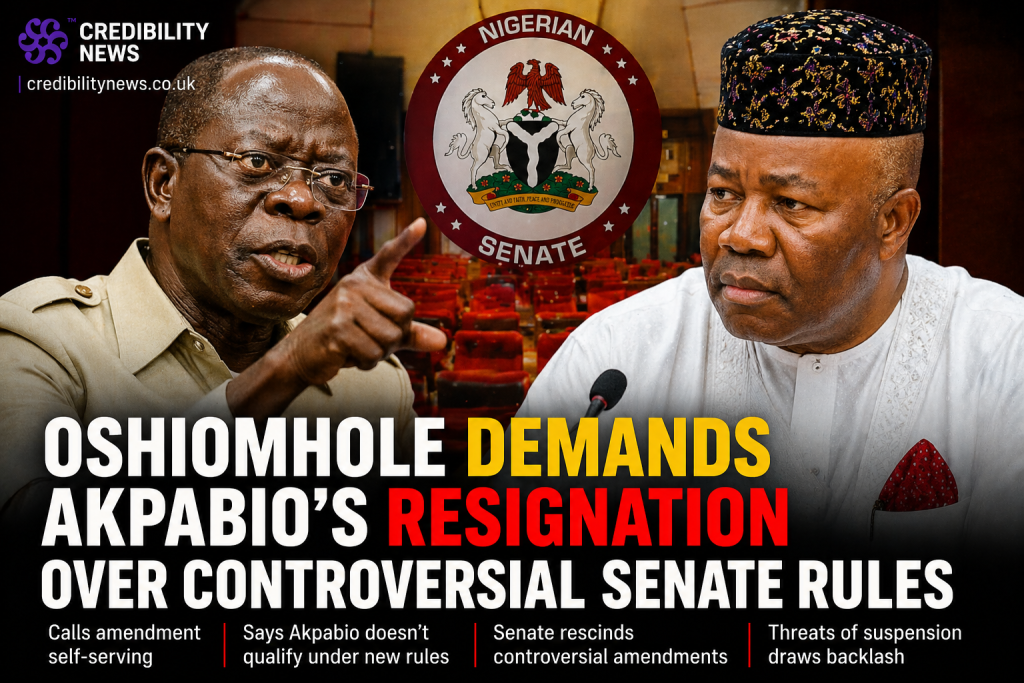
The Nigerian Senate was thrown into a fierce constitutional and political storm this week as Senator Adams Oshiomhole, representing Edo North on the platform of the All Progressives Congress (APC) and serving as Chairman of the Senate Committee on Interior, fired a stunning broadside at Senate President Godswill Akpabio, demanding his immediate resignation over what he described as a deeply flawed and self-serving amendment to the Senate Standing Orders 2026.
Oshiomhole — a former President of the Nigeria Labour Congress, former Governor of Edo State, and former National Chairman of the APC — speaking to journalists in Abuja on Thursday, described the amended rules as rooted in a “moral crisis,” insisting they raised fundamental questions about fairness, eligibility, and leadership ethics in the upper legislative chamber.
The Senator maintained that Akpabio, under the very framework being proposed, would not qualify to preside over the chamber, declaring: “The Senate President became minority leader on his first term. He is now the one presiding and asking us to change those rules — even those who have done one term can’t even contest. So if we pass the rule that we must do eight consecutive years before you can become Senate President, it means he has to lead by example by vacating.”
It was a surgical indictment — using the Senate President’s own proposed rules as the instrument of his disqualification.
The upper chamber had on Tuesday amended its Standing Orders to restrict eligibility for Senate leadership positions exclusively to senators who have served at least two consecutive terms of uninterrupted tenure. The amendment effectively disqualified Oshiomhole and all other first-term senators from contesting presiding offices — a development he found both unjust and hypocritical.
He also invoked the legacy of former Senate President David Mark, insisting: “As leaders who are products of by-laws, we must not make laws to perpetrate anyone.”
Oshiomhole additionally alleged that the amendment was rushed through under pressure from vested interests, declaring: “The way we rushed the rules because certain people wanted certain things concluded is one flaw in this process.”
As Chairman of the Senate Committee on Interior — a position with oversight over immigration, civil defence, fire services, and the correctional system — Oshiomhole is no peripheral voice in the chamber. His objection cannot be dismissed as the grievance of a fringe legislator. It is the protest of a senior committee chairman who believes the institution he serves is being manipulated for private political gain.
Rather than engaging the substance of these constitutional concerns, the Senate leadership reached for a tool that has become disturbingly familiar in Nigeria’s legislative history — the threat of suspension.
Senate President Akpabio warned on the floor of the chamber: “If any member becomes unruly in the Senate, such a member will be asked to leave. This is the final warning.” The Chief Whip similarly threatened disciplinary action, while the Senate Leader cautioned that “unnecessary drama” would no longer be tolerated.
This reaction raises a question every Nigerian deserves an honest answer to: Why is the Senate so quick to silence dissent with threats of suspension rather than engaging the democratic right of every elected senator to speak freely on behalf of those who elected them?
Every senator in the red chamber was elected — in many cases through fiercely contested races — by Nigerian citizens who expect their representative to speak boldly, challenge injustice, and hold even the most powerful office holders accountable. To threaten a senator with removal simply for holding a dissenting opinion is an affront to democratic principles and a direct assault on the mandate given by Nigerian voters. That threat is not aimed at one senator alone — it is aimed at every constituency that senator represents.
Decorum in legislative proceedings is a necessary convention, and senators must conduct themselves with dignity. However, there is a critical distinction between disorder and dissent. Oshiomhole was raising constitutional questions of national significance. Vigorous disagreement on such matters is not disorder — it is democracy in its most essential form.
A Senate that cannot accommodate a minority voice has confused authority with domination. The presiding officer must always remember that his mandate flows from the same democratic process that gave every other senator the right to sit, speak, and be heard.
In a dramatic reversal that vindicated those who raised the alarm, the Senate on Thursday rescinded the controversial amendments to its Standing Orders 2026, acknowledging that several of the provisions were inconsistent with the 1999 Constitution. The chamber formally resolved to rescind its earlier decisions relating to amendments made to Order 2 Subsection 2 and Order 3 Subsection 1.
The Deputy Senate President, Jibrin Barau, who presided over the session, stated simply: “It’s just for us to go in conformity with the Constitution.”
The reversal, while welcome, must not obscure what actually transpired. The Senate rushed through an amendment later conceded to be unconstitutional, allegedly under pressure from political interests. When a senior committee chairman rose to say so publicly, the first instinct of leadership was not reflection — it was retaliation.
The political backdrop is equally telling. The amendments emerged amid intense jockeying for power ahead of 2027, with no fewer than ten serving governors and several former governors positioning to enter the Senate and contest top leadership roles. Unconfirmed but widely circulated reports suggest the amended rules were designed to protect Akpabio’s position against the speculated ambition of Imo State Governor Hope Uzodinma to contest the Senate Presidency in the 11th Senate.
Senator Oshiomhole may not be a perfect messenger. But his message — that no leader is above the rules, that the Senate cannot be an instrument of personal entrenchment, and that every elected senator has the right to speak without fear of reprisal — deserves to be permanently inscribed in the culture and conscience of Nigeria’s upper legislative chamber.
The Senate President has been called upon to resign. Whether or not that call is heeded, one thing is beyond dispute: the Nigerian people are watching, and in 2027, they will have their say.
For comments, reflections, and further conversation:
Email: samuelagogo4one@yahoo.com
Phone: +2348055847364