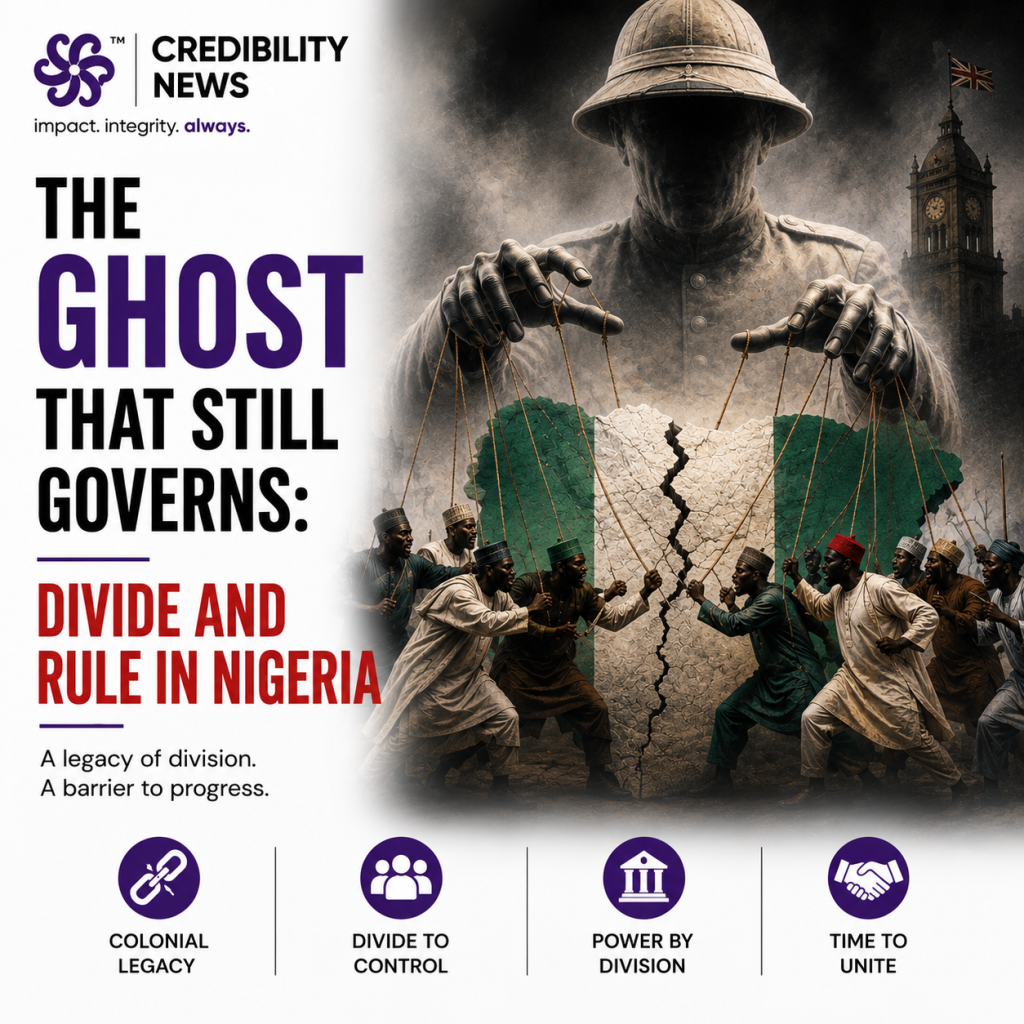
Nigeria’s story is one of extraordinary promise constantly undermined by a shadow that refuses to fade — the ghost of divide and rule. This strategy, planted by colonial administrators more than a century ago, has become the most enduring inheritance of British rule. It was designed to splinter communities, to keep them suspicious of one another, and to ensure that unity never threatened the power of those at the top. Long after the colonial masters departed, the system remained, refined and perpetuated by Nigerians themselves.
The origins of this ghost lie in 1914, when Lord Frederick Lugard merged the Northern and Southern Protectorates into one entity. His system of Indirect Rule governed through traditional and religious leaders, locking ethnic groups into separate administrative units. He did not attempt to bridge the gap between Yoruba, Igbo, Hausa, Fulani, and the hundreds of other nationalities. Instead, he deepened it. Education policy widened the divide further: missionary schools thrived in the south, while the north resisted Western learning under the influence of Emirs. By independence in 1960, Nigeria was already split into regions so unequal in literacy, civil service representation, and political orientation that unity seemed impossible.
The First Republic collapsed under the weight of these divisions. Politics was not about ideology but about tribe. Elections were rigged along ethnic lines, alliances were tribal bargains, and crises like the census controversies of the early 1960s exposed the fragility of the system. The coups of 1966, the pogroms against the Igbo, and the Biafran War that followed were not born of natural hatred but of structures deliberately designed to pit communities against one another.
The Nigerian Civil War, fought between 1967 and 1970, was the most devastating consequence of this colonial inheritance. When the Eastern Region, led by Colonel Odumegwu Ojukwu, declared independence as the Republic of Biafra, it was not simply an act of secession — it was the culmination of years of mistrust, ethnic violence, and political manipulation. The war claimed over a million lives, many of them civilians who died from starvation as blockades cut off food supplies to Biafra. Families were torn apart, communities destroyed, and the trauma of that conflict still lingers in Nigeria’s collective memory.
The war’s impact was profound. It hardened ethnic identities, deepened mistrust between regions, and created a culture of suspicion that has never fully healed. For the Igbo, the war reinforced feelings of marginalisation that continue to shape politics in the southeast. For the rest of Nigeria, it entrenched the idea that unity was fragile and could collapse under pressure. The war also militarised Nigerian politics, paving the way for successive military regimes that ruled with the same divide-and-rule tactics inherited from colonial administrators.
The discovery of oil in the Niger Delta added fuel to the fire. Suddenly, there was immense wealth to fight over, and military rulers from Gowon to Abacha manipulated ethnic and regional differences to consolidate power. States were created not to empower citizens but to fragment rivals and multiply patronage networks. Babangida institutionalised zoning and federal character principles, then annulled the 1993 election — the freest in Nigeria’s history — because it suggested Nigerians could vote across ethnic lines. The lesson was clear: unity was dangerous to those who thrived on division.
When democracy returned in 1999, hope surged. Nigerians believed democracy would dissolve the poisons of division. But the Fourth Republic quickly fell into old patterns. Politicians leaned on identity politics, calculating votes by tribe and religion. Religion itself became a weapon, with twelve northern states adopting Sharia law around 2000 as a political manoeuvre to assert northern identity. Insurgencies soon followed: Boko Haram in the northeast, banditry in the northwest, separatist agitation in the southeast, and militancy in the Niger Delta. Each crisis was unique, but all were symptoms of a system that thrived on division.
Divide and rule today operates through subtle but powerful mechanisms. The indigene-settler distinction denies rights to millions who are not considered “indigenes” of their area, even after generations of residence. Zoning reduces governance to identity arithmetic, ensuring that offices are rotated by ethnicity rather than competence. Security crises are manipulated for political gain, with violence fuelled and prolonged to mobilise communities at election time. The media, too, often amplifies ethnic narratives, turning local conflicts into national crises of identity.
The consequences are devastating. Governance has become the management of grievances rather than the pursuit of national interest. Legislatures stall reforms not because they are bad ideas but because they threaten ethnic arrangements. Presidential contests revolve around which group’s “turn” it is, drowning out serious policy debates. Security conflicts are framed as ethnic wars, making solutions elusive. Economic reforms fail because every policy is read through the lens of identity.
The human cost is borne most heavily by Nigeria’s youth. Unemployment is among the highest in the world. Education is crippled by underfunding and strikes tied to revenue-sharing disputes. Healthcare is neglected, while officials seek treatment abroad. Talented Nigerians leave in droves, fuelling one of Africa’s largest brain drains. The diaspora thrives abroad, while at home corruption and incompetence flourish under ethnic patronage. Nigeria’s immense resources and talent are squandered because division is prioritised over opportunity.
And yet, resistance exists. The EndSARS protests of 2020 united young Nigerians across ethnic and religious lines against police brutality. The movement demanded dignity and justice, not tribal protection. The 2023 elections revealed a growing appetite for competence over identity, with Peter Obi’s campaign drawing multi-ethnic, urban youth support. Though he did not win, the movement signalled a shift in consciousness.
Nigeria cannot afford to remain trapped in the cycle of division. Remedies must be bold, deliberate, and sustained. National reconciliation is essential, with truth and reconciliation commissions confronting the legacy of the Civil War and ethnic violence, allowing communities to heal and fostering trust. Constitutional reform must replace zoning and indigene-settler distinctions with merit-based systems that prioritise competence and citizenship over ancestry. Education investment must equalise access to quality schooling across regions, breaking the cycle of inequality that fuels mistrust. Economic inclusion must ensure fair distribution of resources, particularly oil wealth, so that no region feels excluded. Media responsibility must be encouraged, with journalism that avoids ethnic framing and promotes national unity. Youth empowerment must create opportunities in technology, agriculture, and entrepreneurship, giving young Nigerians reasons to stay and build the nation. Security reform must address conflicts as resource disputes rather than ethnic wars, focusing on land, water, and climate solutions.
Nigeria’s tragedy is that divide and rule, once imposed by colonial masters, is now perpetuated by Nigerians themselves. Governance has become the management of grievances rather than the pursuit of national interest. But the seeds of resistance — youth movements, civil society, and cross-ethnic campaigns — suggest that the story is not finished. The challenge is immense: to replace identity politics with competence, to prioritise national projects over the “national cake,” and to build trust across divides. The ghost of divide and rule still governs, but it need not be eternal. Nigeria’s future depends on whether its people can finally exorcise it.
For comments, reflections, and further conversation:
Email: samuelagogo4one@yahoo.com
*Phone: +2348055847464*