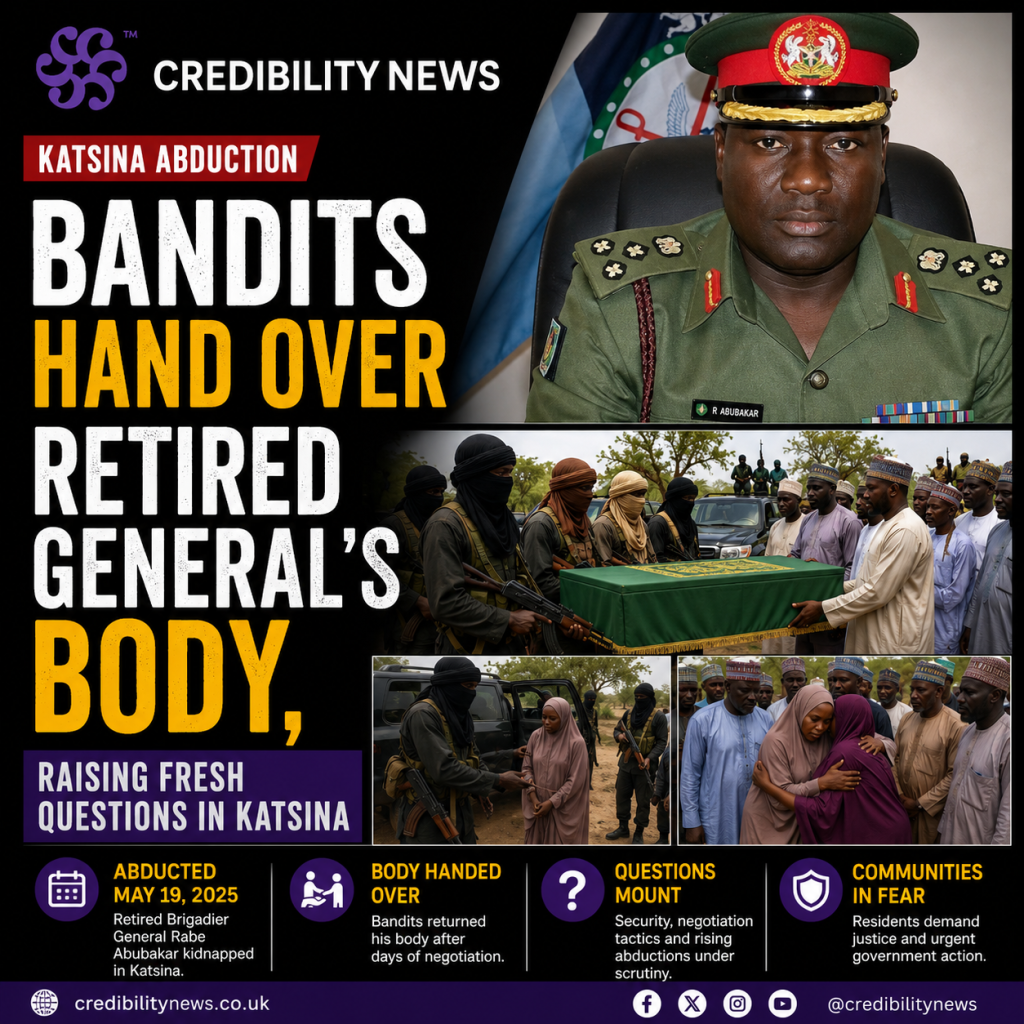
In a development that has shocked many Nigerians and renewed concerns about security in the country’s northwest, the body of retired Major General Rabe Abubakar—who was kidnapped alongside his wife and driver in Katsina State—has been released to authorities and buried according to Islamic rites.
Major General Rabe Abubakar (rtd), a former Director of Defence Information who served as the Nigerian military’s spokesman between 2015 and 2017, was abducted on May 30, 2026, while travelling to attend a wedding in Katsina State. The incident occurred along the Matazu axis, an area that has witnessed repeated bandit attacks and kidnappings.
The Katsina State Government confirmed that the retired officer died while in captivity. According to the state’s Commissioner for Internal Security and Home Affairs, Dr. Nasir Mu’azu, Abubakar succumbed to complications related to diabetes and hypertension, despite efforts by the state government and security agencies to secure his release.
Reports indicate that the late general’s body was returned and subsequently released to his family for burial on Sunday, June 14, 2026. However, details surrounding the handover remain unclear, prompting public debate and calls for greater transparency.
The circumstances have generated a number of questions among the public and security observers, including:
- How contact was established between the abductors and authorities to facilitate the return of the body.
- Whether security agencies attempted to track or intercept those involved in the handover.
- How the official cause of death was determined, and whether further medical examinations were conducted.
- The current status and condition of the late general’s wife, whose whereabouts have not been officially clarified.
Adding to the uncertainty, one of the late general’s sons has reportedly questioned aspects of the official account, citing visible marks on his father’s leg and suggesting that further clarification may be needed regarding the exact circumstances of his death.
The incident has reignited concerns about the effectiveness of efforts to combat banditry in Katsina State and across Nigeria’s northwest region.
Despite ongoing military operations and security initiatives aimed at dismantling criminal networks, kidnappings and attacks continue to affect communities across the region, including prominent individuals and public officials.
The case has also renewed public discussion about the broader challenges of intelligence gathering, hostage recovery, and accountability in the fight against armed criminal groups.
While various public figures have previously commented on insecurity in the northwest, no evidence has been presented linking any individual outside the criminal groups responsible for the abduction to this specific case.
Governor Dikko Umaru Radda described the incident as a “dark moment” for Katsina State and extended condolences to the family of the deceased.
The governor reaffirmed his administration’s commitment to working with federal authorities and security agencies to combat banditry and to bring those responsible for the retired officer’s abduction and death to justice.
Federal authorities have yet to provide detailed public information regarding the circumstances surrounding the general’s death and the return of his body.
Major General Rabe Abubakar was widely respected within military circles and remembered by colleagues as a dedicated officer who served his country with distinction.
Many have described his death at the hands of the criminal elements he spent much of his career helping to combat as a tragic and painful irony.
Family members, military officers, government officials, and residents attended his burial, paying tribute to a man who dedicated decades of service to Nigeria.
As questions surrounding the incident persist, many Nigerians continue to call for a thorough and transparent investigation into the kidnapping, the circumstances of the general’s death, the return of his body, and the fate of those who may still be in captivity.
For many observers, the case has become a symbol of the broader security challenges confronting the nation and the urgent need for lasting solutions to the persistent threat of banditry.