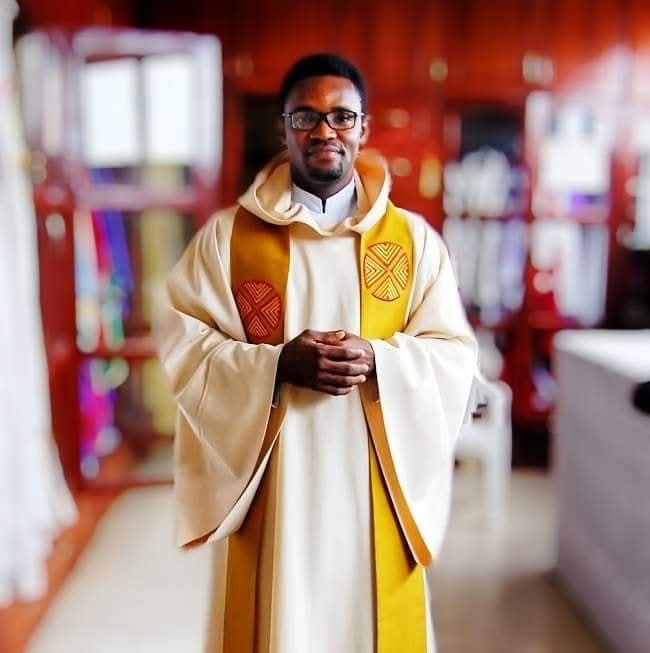
A Catholic priest, Rev. Fr. Kelvin Ugwu, has defended the Catholic Church’s prohibition against clerics holding public offices involving the exercise of civil power, arguing that the restriction is intended to preserve the priesthood’s universal pastoral role.
Ugwu made the remarks in a social media statement titled “The Church Is Wise,” while commenting on the political activities of Benue State Governor Hyacinth Alia, a former Catholic priest.
He cited Canon 285 §3 of the Catholic Church’s Code of Canon Law, which states: “Clerics are forbidden to assume public offices which entail a participation in the exercise of civil power.”
According to Ugwu, the provision reflects the Church’s understanding of the potential conflict between priestly responsibilities and political office.
“Politics divides. There will always be those who support you and those who oppose you,” he said, adding that a priest is expected to be “a father to all.”
He argued that political office could make it difficult for a priest to maintain neutrality and minister to people across political, social, and economic divides. “A priest should not sacrifice his universal fatherhood on the altar of political ambition,” Ugwu said.
The cleric further noted that disregarding legitimate Church authority could attract canonical consequences, stressing that good intentions did not override Church law. “Good intentions do not cancel Church law,” he said.
Ugwu also referred to the political disagreements involving Governor Alia and Peter Obi, describing the situation as an example of the tensions that can arise when a former priest becomes a political actor.
He questioned whether such disputes could affect public perceptions of the Catholic Church, particularly when political disagreements become associated with the Church’s identity or position. “People begin to associate the Church with a political party, a governor, a political position, or a particular faction,” he said.
According to him, the Church’s restrictions on clerics holding political office should be understood as a form of protection rather than merely a limitation. “Sometimes what we interpret as a restriction is actually protection. Sometimes obedience is wiser than ambition,” Ugwu said.
He concluded that political power was temporary, while the responsibilities associated with priesthood were enduring. “From the day Fr Alia chose his personal ambition over the priesthood, I knew the Church will be dragged,” he said.