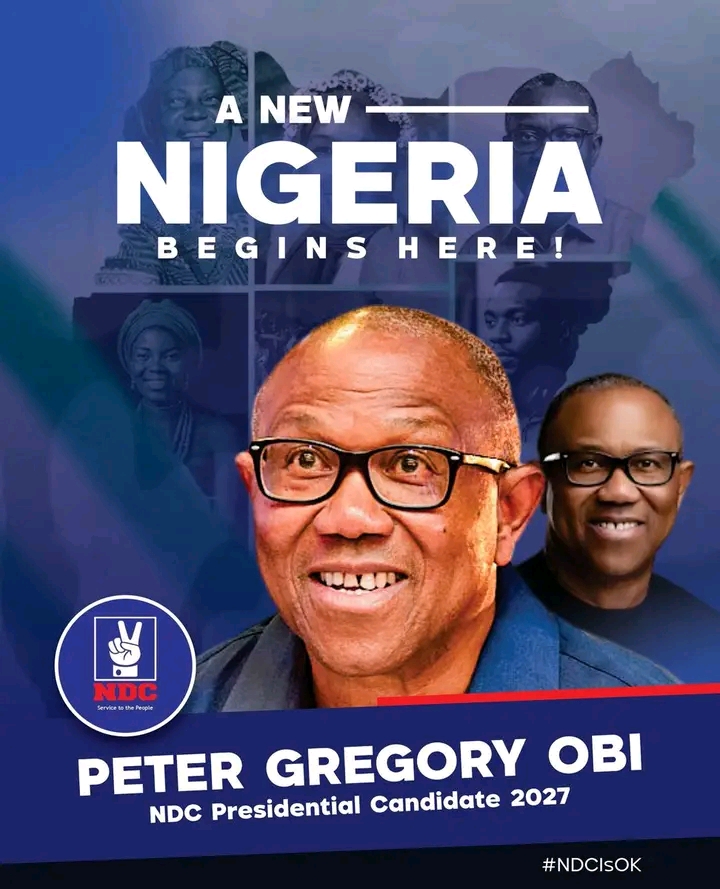
ABUJA, NIGERIA – Peter Obi, the former governor of Anambra State and the Labour Party’s presidential candidate in the 2023 election, has emerged as the Nigeria Democratic Congress (NDC) candidate for the 2027 presidential election.
Obi was affirmed as the party’s candidate at its special convention held in Abuja on May 30, 2026. The motion for his affirmation was moved by Senator Victor Umeh, representing Anambra Central, and seconded by Senator Omo Agege of Delta State.
Immediately after the party’s flag was handed over to him, Obi announced Senator Rabiu Musa Kwankwaso as his running mate.
In his acceptance speech, Obi declared that “a new Nigeria is possible,” outlining an ambitious agenda centred on national unity, tackling insecurity, and overhauling critical sectors including healthcare, education, agriculture, energy, and employment.
The presidential candidate painted a sobering picture of Nigeria’s current challenges while expressing strong optimism about the country’s future. He emphasised his track record of fulfilling campaign promises.
Unity as the Foundation
The candidate stressed that unity is the bedrock of national progress.
“Nigeria cannot advance while fragmented by ethnic, religious, regional or political divides. It is impossible,” he said.
“We must build bridges where people erect walls, replace mistrust with confidence, division with understanding, and resentment with a collective purpose.”
Worsening Insecurity
Obi highlighted the deteriorating security situation, noting that Nigeria has risen from eighth to fourth place among the world’s most terrorism-impacted countries between 2022 and the present. He contrasted this with Nigeria’s past reputation as a major contributor to global peacekeeping missions.
“No nation can thrive when citizens can no longer sleep with their eyes closed, farmers can no longer go to their farms, and nobody is safe,” he said.
He expressed confidence in the party’s depth of experience — particularly members with defence and security backgrounds — to tackle the crisis urgently.
Healthcare, Education and Human Capital Development
The candidate criticised Nigeria’s low life expectancy of 54 years and poor global health ranking. He noted that only 10–20% of the country’s 30,000 primary healthcare centres are functional, while health insurance coverage remains below 10%.
His commitments include:
- Raising health insurance coverage to more than 20% within four years.
- Making 50% of primary healthcare centres fully functional.
- Increasing the health budget allocation to 10% of total government expenditure (or “to 10% of GDP” — keep as is if that is the direct quote).
On education, he lamented the more than 20 million out-of-school children and pledged massive investment to drastically reduce that number through increased funding and stronger accountability mechanisms.
Agriculture and Food Security
Addressing hunger and food insecurity, Obi noted Nigeria’s decline on the Global Hunger Index, from 109th to 115th position, and warned that 35 million Nigerians face the risk of hunger this year despite the country’s vast arable land.
He argued that Nigeria has more arable land per capita than major rice-producing nations such as India, Bangladesh, and Vietnam, yet produces far less.
“We can feed ourselves and become a net exporter of food. I have always maintained that we can make more money from the vast land in the North than we make from oil. This laziness must stop,” he said.
Energy and Employment
Obi described Nigeria’s energy crisis as “totally unacceptable,” noting that approximately 100 million citizens lack access to electricity and that national power generation remains at around 4,000 megawatts — far below the levels of South Africa and Egypt despite Nigeria’s larger population.
He pledged to increase power generation and distribution capacity to at least 10,000 megawatts within four years.
On unemployment, he dismissed official figures of around 4% as unrealistic, arguing that the true rate is above 30% overall and exceeds 40% among young people. He promised aggressive support for micro, small and medium-sized enterprises (MSMEs) through improved access to affordable credit, citing Indonesia as a successful model.
Governance, Corruption and Rule of Law
The candidate vowed to drastically reduce the cost of governance, curb corruption, and strengthen the rule of law.
“We cannot continue to ask people to fast while we are feasting. You cannot continue to tell people who do not know where their next meal is coming from that sacrifices must be made while you are buying new jets,” he said.
He also cited his experience as governor, where he successfully navigated legal challenges without compromising the judiciary, as evidence of his commitment to independent institutions.
Party Supremacy and Democratic Values
Obi emphasised that under an NDC government, the party would remain supreme, with the vice president functioning as a genuine partner rather than a “spare tyre.” He criticised what he described as the harassment of opposition parties and the denial of access to public venues, promising a more inclusive democratic environment.
Further details of the party’s manifesto and additional policy proposals are expected to be unveiled in subsequent engagements.
One of the highlights of the event was a special Atelogon dance performance by Nigerian youths, as well as goodwill messages from notable figures such as Buba Galadima, who urged party faithful and supporters to stand firm, remain courageous, and always defend their votes.