
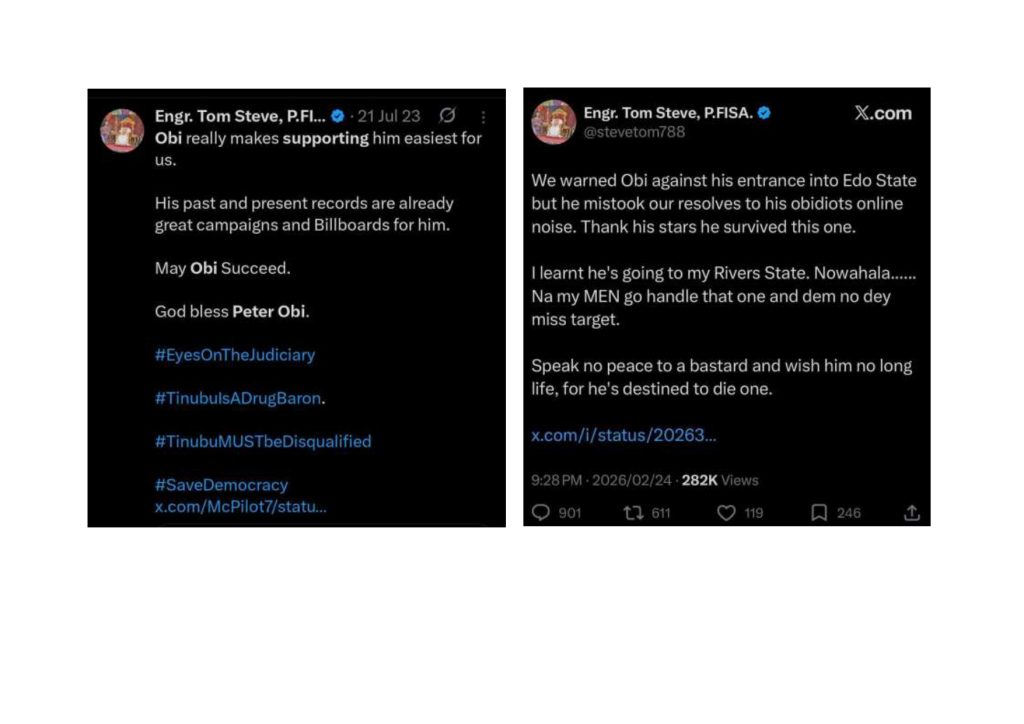
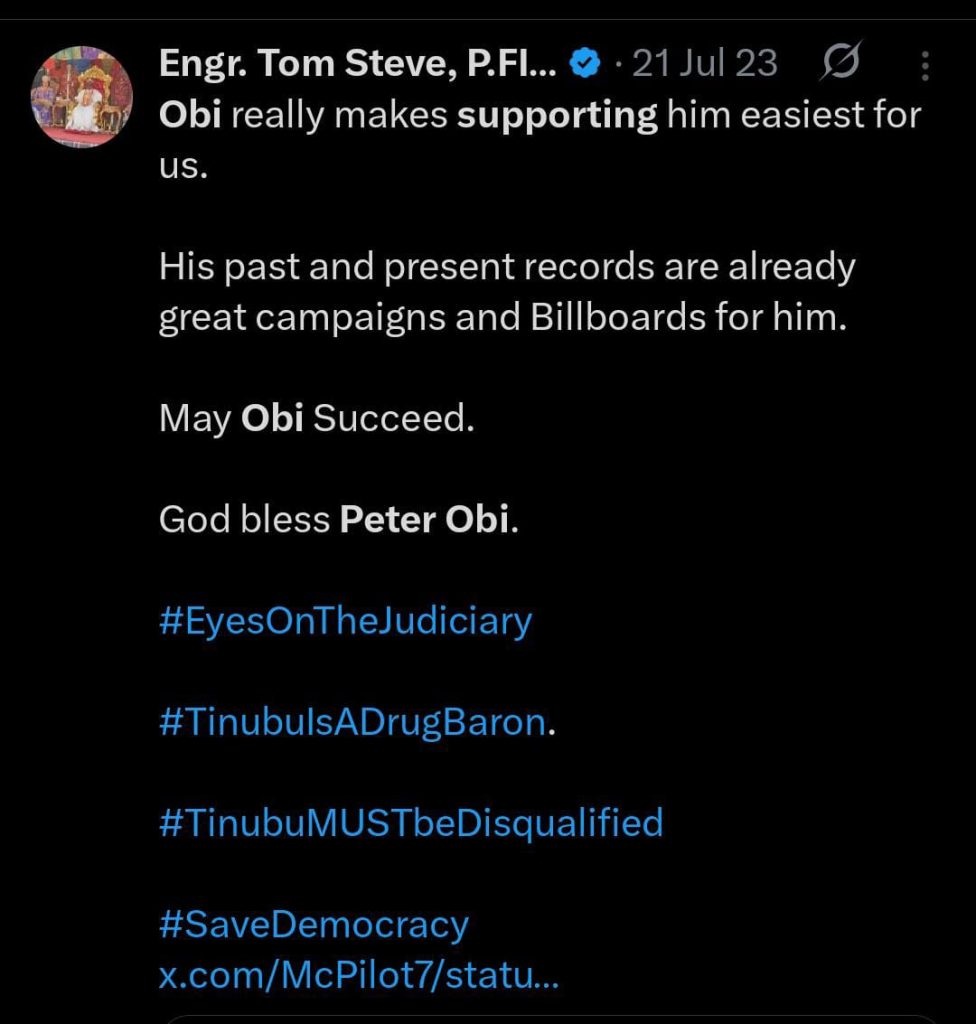
Engr. Tom Steve, P.FISA (@stevetom788)’s online persona is a symptom of a deeper Nigerian malaise. Cloaked in activist language yet steeped in threats, ethnic bile, and open incitement, his posts show how easily lawlessness now migrates from the streets to social media—unchecked, rewarded, and dangerously normalised.
When voices like his can hint at violence, celebrate it, or promise it without consequence, the message is clear: intimidation has become a political tool, and impunity its shield. That grim reality echoes the anguish of Mike Igini, the former INEC Resident Electoral Commissioner who recently confessed regret over a decade spent trying to protect Nigeria’s electoral process.
In a recent Arise TV interview, former INEC Resident Electoral Commissioner Mike Igini expressed profound regret over his decade of service. He lamented the killing of colleagues—including one in Kano—who paid the ultimate price for attempting to uphold electoral integrity.
“I regret wasting my 10 years working for INEC,” Igini said. “I would have been dead by now.”
His words underscore a bitter reality: in Nigeria, those who strive for justice often face mortal danger, while impunity appears to reward the opposite.
This culture of lawlessness was starkly illustrated by the February 24, 2026, incident in Edo State, where former presidential candidate Peter Obi narrowly escaped what witnesses and reports describe as a suspected assassination attempt.
Gunmen attacked an African Democratic Congress (ADC) gathering in Benin City, firing shots, destroying vehicles, and riddling gates with bullets. Obi and other leaders survived, but the attack has raised grave concerns about political violence ahead of future elections.
Even more disturbing than the incident itself are the public statements that appeared to endorse—or foreshadow—harm to Obi. Edo State Governor Monday Okpebholo had earlier warned that Obi’s security could not be guaranteed without clearance to enter the state. Echoing this sentiment, the state’s Commissioner for Information, the APC chairman, and others issued pointed remarks.
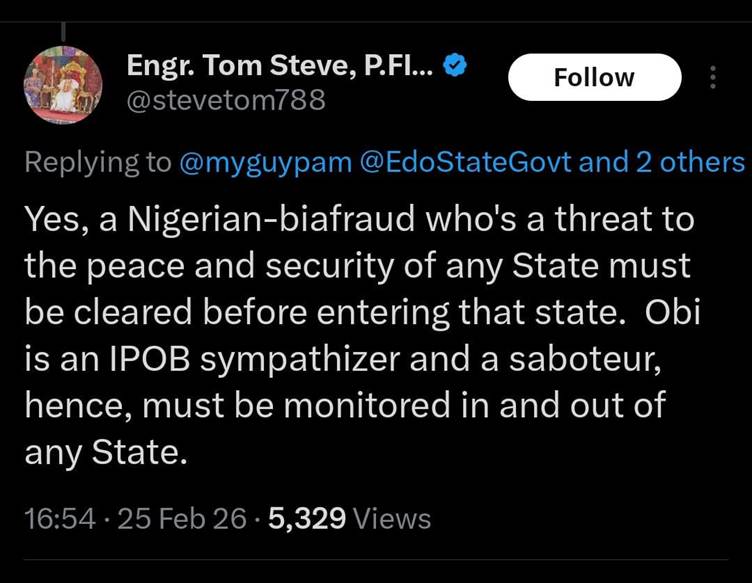
Among them was X user Engr. Tom Steve, P.FISA (@stevetom788), who on February 25, 2026—the day after the attack—publicly demanded Obi’s immediate arrest and interrogation for allegedly defying the governor’s directive. He labeled Obi an “IPOB sympathiser and a saboteur,” framing his visit as a threat to state security and regional order.
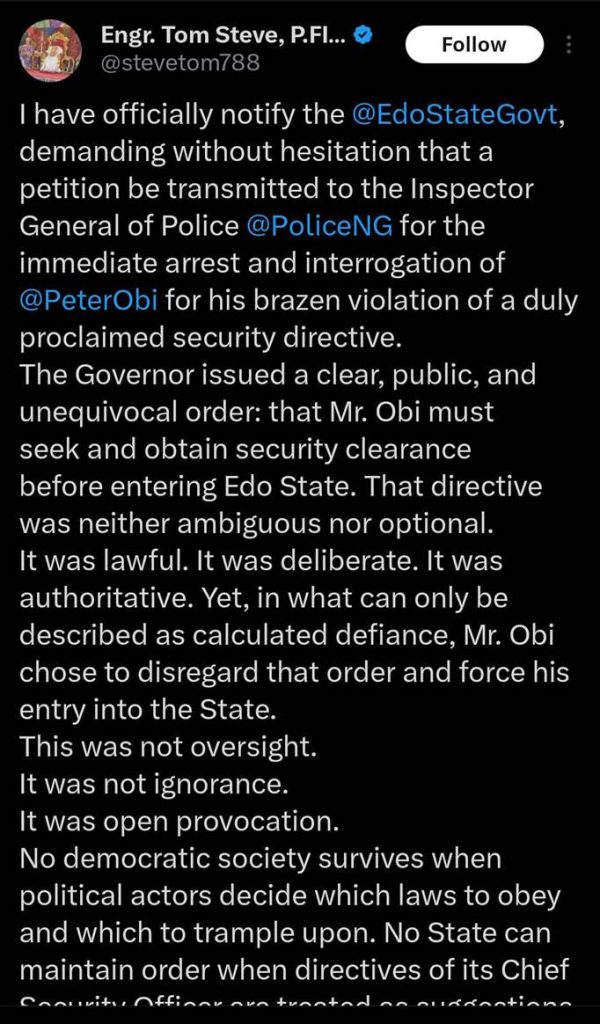
@stevetom788’s February 25, 2026, post demanding Obi’s arrest, labeling him an “IPOB sympathiser and a saboteur,” and related demands.
This piece focuses on @stevetom788 as a troubling example of unchecked online incitement and ethnic divisiveness. Self-described as a Niger Delta activist opposed to oppression, corruption, and injustice, his account—boasting approximately 4,793 followers and blue verification—reveals a stark contradiction between proclaimed ideals and actual conduct.
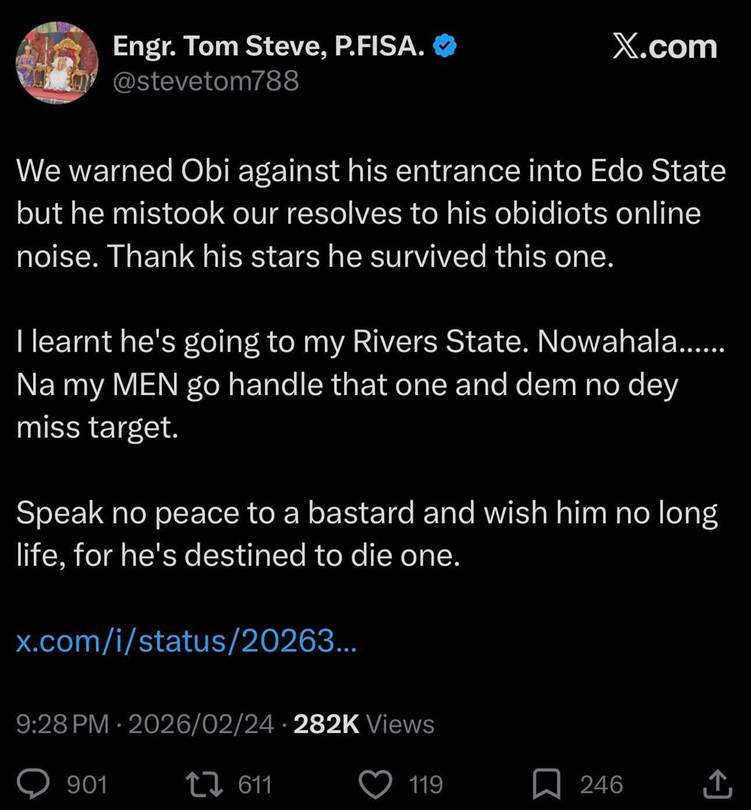
Compounding the danger, on February 24, 2026—the very day of the Edo attack—@stevetom788 posted a chilling follow-up. He gloated over Peter Obi’s survival while issuing an explicit threat ahead of a rumoured visit to Rivers State. In his words: “Na my MEN go handle that one and dem no dey miss target… Speak no peace to a bastard and wish him no long life, for he’s destined to die one.”
This post, which quickly garnered hundreds of reposts and hundreds of thousands of views, openly invokes violent “handling” of Obi in Port Harcourt, with the claim that his group “no dey miss target.” Coming mere hours after a real armed incident in Edo, it escalates from online rhetoric to what many see as a credible veiled threat—further underscoring the unchecked spread of dangerous incitement in Nigeria’s polarized political space.
A Dramatic Shift in Allegiance
Posts from 2023 show @stevetom788 strongly supporting Peter Obi during the election crisis, portraying him as a victim of electoral fraud and a calming influence. In an April 2023 post, he warned that without Obi’s restraint, violence might have erupted in the Niger Delta.
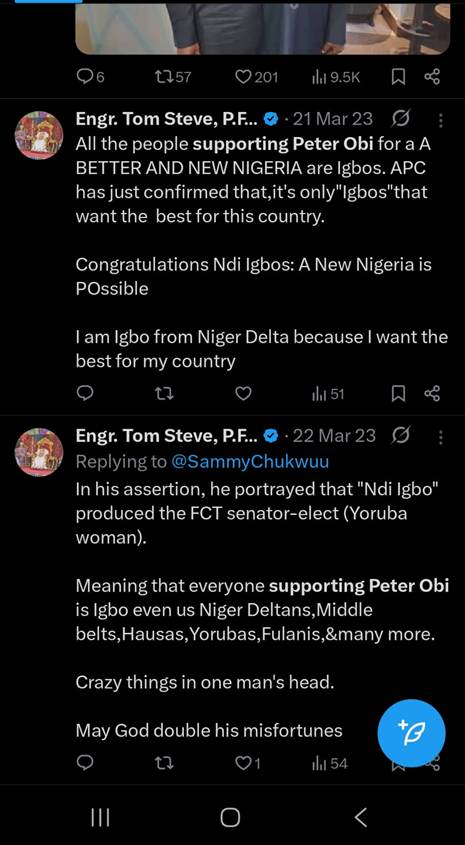
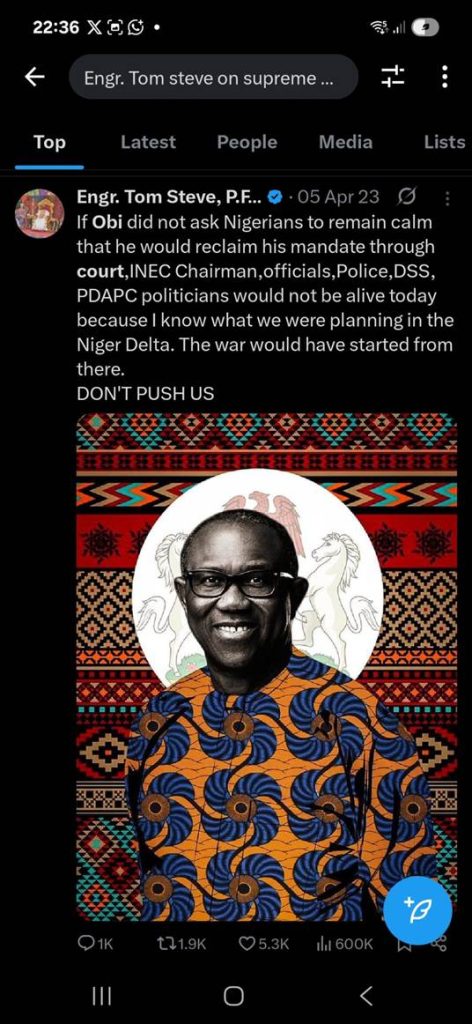
Relevant 2023 post(s) showing support for Obi, e.g., the April 29, 2023, post praising Obi’s arrival at an event or defending him against critics.
By 2025–2026, however, his rhetoric had turned sharply hostile. He began branding Obi a “political opportunist” who “thrives on the labour of others,” lacks leadership capacity, and cannot “build” or “lead.” In a lengthy post, dated February 25, 2026, he declared:
“Peter Obi shall not ascend to the presidency of the Federal Republic of Nigeria.”
In the same post, he praised President Bola Tinubu, Senate President Godswill Akpabio, and Nyesom Wike—all figures aligned with the ruling APC and South-South political interests. This abrupt pivot appears linked to Obi’s criticisms of the current administration and his political repositioning, suggesting opportunism rather than principled activism.
Ethnic Bigotry and Hate Speech
More alarmingly, @stevetom788 has repeatedly targeted the Igbo ethnic group with inflammatory generalizations. His posts accuse Igbos en masse of criminality—claiming that 99 percent are “drug barons, ritualists, and kidnappers”—and portray them as tribalistic saboteurs. He has employed slurs such as “biafrauds,” “picnic rats,” and “evil tribe,” while framing South-South interests as inherently opposed to alleged Igbo agendas, including selective attacks on Ibom Air while defending Air Peace.
Such rhetoric dangerously inflames ethnic tensions in a multi-ethnic nation still grappling with the scars of past conflicts.
One or more examples of ethnic-slur posts, e.g., recent uses of “picnic rats,” “biafrauds,” or broad accusations against Igbos (such as replies calling critics “picnic rats” or blaming “Igbos” for incidents). This visually substantiates the pattern of bigotry.]
Direct Incitement to Violence
A post dated November 23, 2025, crosses into outright incitement. In it, @stevetom788 offered weapons (“Gee,” slang for gun) exclusively to “devout Christians from northern Nigeria,” urging them to counter “Allahu Akbar” chants with “God Is the Greatest” gunfire at a specified time and location. In Nigeria’s volatile North—where sectarian violence has claimed countless lives—this call to arm one religious group against another is reckless and potentially criminal.
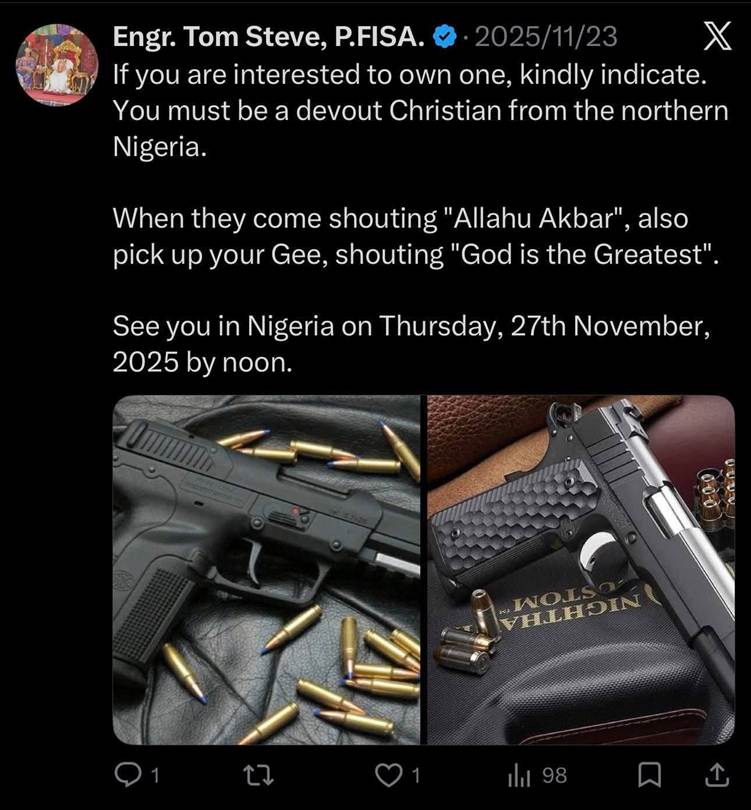
The November 23, 2025, post offering “Gee” to northern Christians and urging armed response to “Allahu Akbar” chants.
This is critical evidence of incitement. Although this particular post does not mention Obi or the Igbo people directly, it fits a broader pattern of divisive messaging fundamentally opposed to Obi’s long-standing advocacy for national unity, interfaith harmony, and peaceful reform. As an Igbo Catholic, Obi has consistently championed dialogue across ethnic and religious lines—precisely what such rhetoric seeks to undermine.
The Impunity Syndrome
The trajectory of @stevetom788—from Obi supporter to promoter of ethnic vilification and religious confrontation—exemplifies the impunity Mike Igini decried. In any functioning democracy, repeated hate speech and incitement to violence would provoke swift legal consequences. Yet in Nigeria, such voices continue to flourish unchecked on social media, emboldened by a system in which accountability appears selective and inconsistent.
This is not a matter of free speech. It is a match struck dangerously close to a powder keg.
A Call to Action
Authorities must treat online incitement with the urgency it demands—before rhetoric translates into further bloodshed. Nigeria deserves leaders and citizens who build bridges, not those who profit from tearing them down. The alternative is a nation where lawlessness does not merely thrive—it prevails.