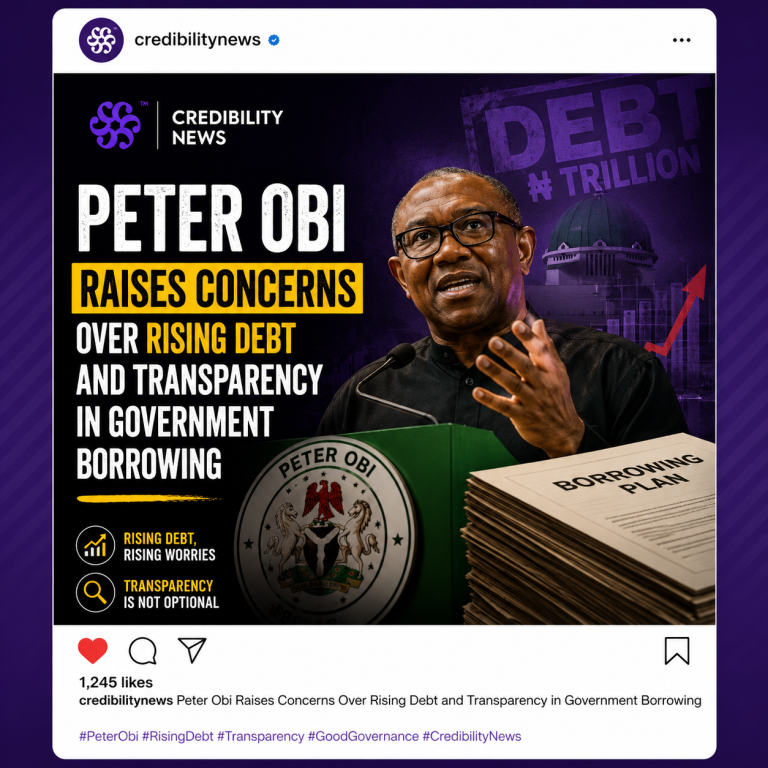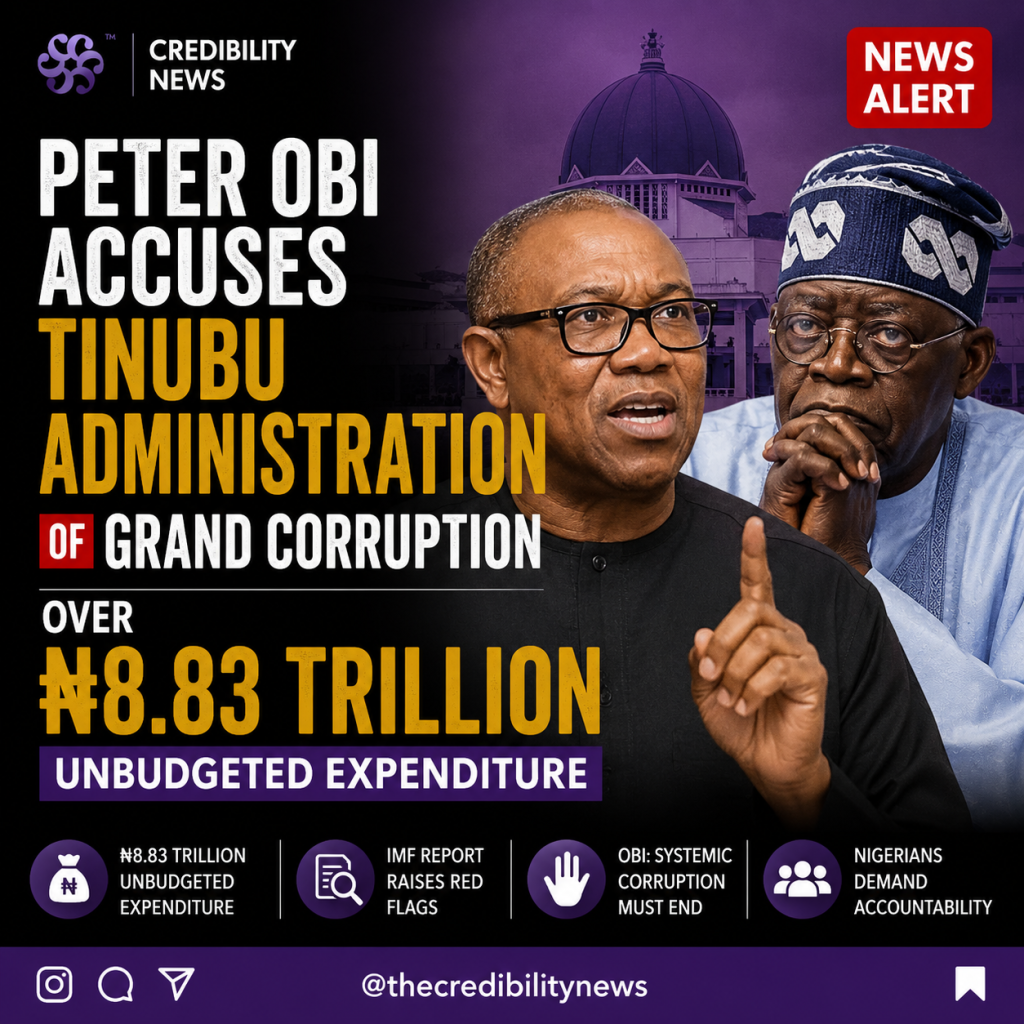
NIGERIA – Former Anambra State Governor and opposition leader Peter Obi has accused the administration of President Bola Tinubu of “grand corruption,” citing a recent International Monetary Fund (IMF) assessment which he said revealed approximately ₦8.83 trillion in government expenditure for 2025 that was not reflected in the national budget.
In a post published on X on Sunday, Obi argued that the reported off-budget expenditure lacked legislative approval and adequate public scrutiny, describing it as evidence of systemic failures in fiscal transparency and governance.
According to Obi, the reported expenditure is equivalent to about two per cent of Nigeria’s Gross Domestic Product (GDP) and represents more than 35 per cent of the country’s ₦23.96 trillion capital budget for 2025.
He further noted that the amount exceeds the combined federal allocations to the education and health sectors, which stand at ₦3.52 trillion and ₦2.38 trillion respectively.
Obi argued that, if properly appropriated and transparently managed, the funds could have transformed key sectors of the economy.
He said the resources could have strengthened healthcare and education, created employment through investment in cottage industries, and supported broader economic development.
The former presidential candidate renewed his call for President Tinubu to resign, alleging that the administration had demonstrated incompetence, poor economic management, and insensitivity to the welfare of Nigerians.
“This recent revelation proves that the APC government is grossly corrupt, incompetent and insensitive… the only reasonable action is for President Tinubu to resign from office,” Obi wrote.
He warned that poor fiscal governance could deepen poverty, weaken national security, and further undermine public confidence in government institutions.
Obi also urged Nigerians to pursue accountability through lawful and democratic means, concluding his statement with his familiar slogan: “A New Nigeria is Possible.”
Obi’s comments follow remarks attributed to the IMF’s Resident Representative in Nigeria, Christian Ebeke, who reportedly stated that government spending equivalent to about two per cent of GDP—approximately ₦8.83 trillion—was not captured in recent budget documents, creating a discrepancy in reported fiscal deficits.
The IMF has called for greater fiscal transparency while acknowledging progress made under Nigeria’s ongoing economic reform programme.
The Federal Government has rejected suggestions that the expenditure indicates corruption, describing such interpretations as a misrepresentation of Nigeria’s public finance framework.
Government officials have maintained that the expenditures were handled in accordance with constitutional and fiscal procedures and are reflected in broader public financial reporting.
The exchange has intensified debate over fiscal transparency, public accountability, and economic management as political tensions continue to build ahead of the 2027 general elections.
Obi’s statement attracted significant attention on social media, generating thousands of interactions within hours of its publication.