BERLIN, Germany — Nigeria Democratic Congress -NDC presidential candidate for the 2027 election, Peter Obi has outlined his vision for Nigeria’s future, arguing that competent leadership, economic productivity, national unity, and security reforms are essential to reversing the country’s economic and social challenges.
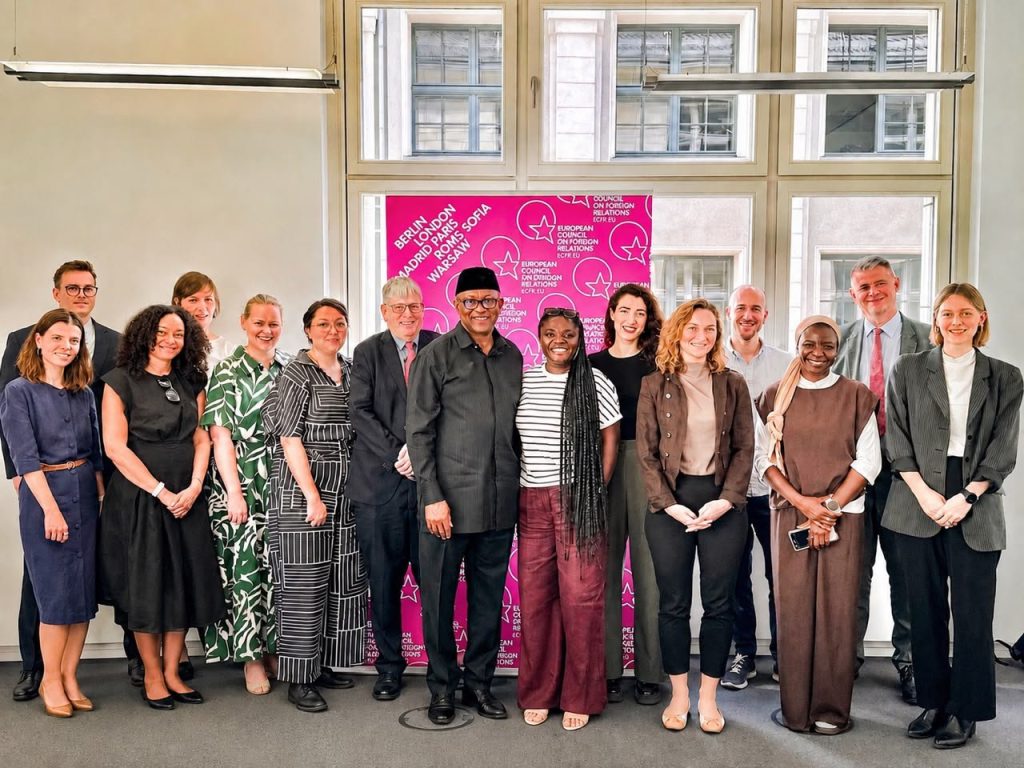
Speaking during a roundtable discussion hosted by the European Council on Foreign Relations (ECFR) in Berlin, Obi engaged policymakers, diplomats, and researchers on issues ranging from governance and the economy to security, foreign policy, and Nigeria’s 2027 general election.
Introducing the session, ECFR Africa Programme Director Andrew Lebovich described Obi as a key figure in Nigeria’s political landscape, noting that he secured more than six million votes in the 2023 presidential election. He said the discussion aimed to provide European policymakers with a clearer understanding of Obi’s vision for Nigeria’s future, particularly on economic reform, job creation, regional security, and international partnerships.
‘Nigeria’s Greatest Challenge Is Leadership’
Responding to questions about his political journey, Obi said he entered politics after a successful career in the private sector because he was convinced that public service offered an opportunity to build “public wealth” rather than personal wealth.
“Nigeria has everything it takes to become a great nation—natural resources, human resources, and entrepreneurial talent. The only thing the country is lacking today is leadership,” he said.
According to Obi, Nigeria’s challenges stem from what he described as years of poor governance characterised by incompetence, lack of compassion, and weak institutional leadership. He argued that addressing corruption and improving accountability would be central to national renewal.
2027 Election
Reflecting on the 2023 presidential election, Obi maintained that he believed he won the contest but alleged that the process was compromised.
Looking ahead to the next election, he expressed confidence that growing public dissatisfaction with economic conditions would shape the political landscape.
“The next election will be between the Nigerian people and those currently in government,” Obi said, adding that his focus was not simply on becoming president but on creating opportunities for future generations.
“I’m not desperate to be president. I’m desperate to see Nigeria work,” he stated.
Economy: Productivity over Consumption
A significant portion of the discussion focused on economic policy.
Obi reiterated his longstanding support for removing fuel subsidies but argued that the policy should have been implemented in phases and accompanied by fiscal discipline and transparent investment of the resulting savings.
He criticised what he described as rising public borrowing despite subsidy removal, questioning whether Nigerians had seen corresponding improvements in education, healthcare, or infrastructure.
“There is nothing wrong with borrowing if it is for productive investment,” he said. “The issue is whether citizens can see where the money has gone.”
Obi argued that Nigeria must shift from a consumption-driven economy to one centred on production, with agriculture, manufacturing, and support for micro, small, and medium-sized enterprises (MSMEs) forming the foundation of economic growth.
He cited Indonesia, Bangladesh, and the Netherlands as examples of countries that had successfully leveraged agriculture and small businesses to drive employment and exports despite geographical or demographic constraints.
Attracting Investment
Asked how Nigeria could attract more German investment, Obi said strengthening the rule of law and ensuring the security of lives and property were fundamental.
He argued that investors require confidence that contracts will be respected and disputes resolved fairly through the courts.
“Foreign investors are like bees looking for honey. If you create the right environment, they will come,” he said.
Obi also called for Nigeria’s diplomatic missions abroad to focus more on promoting trade, investment, and economic partnerships rather than serving primarily as political appointments.
Security and State Policing
On security, Obi described poverty, unemployment, and weak governance as major drivers of criminality.
He advocated combining stronger military and security operations with long-term investments in education, healthcare, and job creation to reduce insecurity.
“The more you pull people out of poverty, the more you reduce criminality,” he said.
Obi also expressed support for state and community policing, arguing that local security structures are often better positioned to respond quickly to emerging threats, provided adequate safeguards prevent political abuse.
National Unity
Obi identified national unity as his first priority if elected president, arguing that political leaders must actively discourage ethnic and religious divisions.
“No tribe buys bread cheaper and no religion buys bread cheaper. Everybody suffers the same economic hardship,” he said.
He maintained that inclusive leadership and equal opportunities would help rebuild trust across Nigeria’s diverse communities.
Foreign Policy and Regional Leadership
Discussing foreign affairs, Obi said Nigeria should restore its traditional leadership role within West Africa and ECOWAS by strengthening dialogue with neighbouring countries.
He also argued that Nigeria’s foreign policy should be anchored on a strong domestic economy while maintaining productive relationships with Europe, the United States, China, and other international partners.
On Nigeria’s diplomatic service, he pledged to prioritise merit and professionalism over political patronage in ambassadorial appointments.
Closing Remarks
As the session concluded, Obi appealed for international support in strengthening democratic institutions and governance in Nigeria.
He argued that Nigeria’s success would have significant benefits not only for Africa but also for Europe through stronger trade, improved regional stability, and expanded economic cooperation.
“We need leadership with competence, capacity, and character,” Obi said. “This is not about one individual. It is about ensuring Nigeria works for everyone.”