

In the space of a single week, two attacks — one in the North-West, the other in the North-East — have laid bare the enduring and expanding nature of Nigeria’s security crisis.
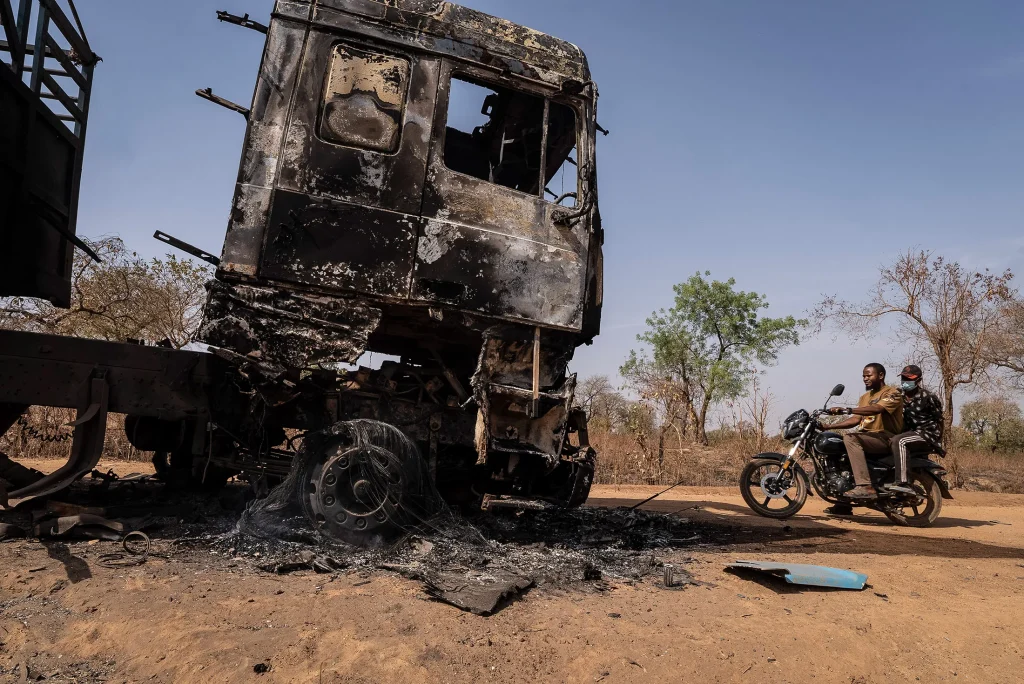
On Tuesday night in Kebbi State, suspected Lakurawa terrorists ambushed security personnel tracking them through Giro Masa in Shanga Local Government Area. Nine soldiers and one policeman were killed. Two military trucks were set ablaze.
The soldiers had been deployed to the area following months of community complaints about the Lakurawa group’s growing presence. Residents had tipped them off about suspicious movement toward a construction company yard. They did not expect the ambush that followed.
More than 1,000 kilometres away, troops of Operation Hadin Kai in Borno State intercepted 18 suspected Boko Haram logistics suppliers along the Gubio–Gudumbali axis. The suspects, according to the Army, were drawn into the illegal trade by economic hardship — a reminder that the insurgency’s reach extends beyond the battlefield and into the everyday desperation of civilians caught between survival and violence. Two incidents. Two regions. One crisis.
The Kebbi Attack: A Community’s Betrayal
For residents of Shanga LGA, the Tuesday night ambush was not just a military loss — it was a personal blow.
“We alerted the soldiers about the movement of the Lakurawa towards a construction company yard,” a source told Credibility News. “We never expected that the soldiers would be ambushed.”
The soldiers had come at the community’s request. Months of Lakurawa activity had left residents living in fear. The deployment was supposed to be a turning point.
Instead, families now mourn soldiers who died defending a community that had asked for their help. The attack also exposed the limits of intelligence-led operations in a region where terrorist groups have become adept at counter-surveillance and ambush tactics.
Kebbi State Governor Nasir Idris visited the mortuary and the Accident and Emergency Unit of the Federal Teaching Hospital in Birnin Kebbi, where victims were taken. He described the attack as barbaric and assured that the state government would cover medical bills and support the families of the deceased.
“This is a sad incident,” the governor said. “These are the soldiers protecting the lives of Kebbi residents, yet they found themselves in this situation.”
But for residents, the question lingers: if the military cannot protect those who invited them in, who can?
The Borno Arrests: Economic Desperation as a Weapon
In Borno, the Army’s announcement of 18 arrests told a different story — one of civilian collaboration, but also of economic vulnerability.
The suspects were intercepted along the Gubio–Gudumbali axis, a route known for militant activity, reportedly moving supplies to terrorist elements.
Preliminary investigations, according to a statement signed by Lieutenant Colonel Sani Uba, revealed that many of the suspects were drawn into the illegal activity due to economic hardship.
It is a pattern that has repeated itself across the North-East for over a decade. As the Boko Haram insurgency has evolved, so too has its reliance on civilian networks — suppliers, informants, and transporters who, often out of economic necessity, become cogs in a machine that feeds violence.
The Army’s warning was stark:
“Providing logistics, intelligence, or any form of assistance to such elements remains a serious offence, with grave consequences for national security and the safety of innocent lives.”
Yet the arrests also highlight a deeper failure: the absence of viable economic alternatives for many in the region. Without sustained socio-economic interventions, the cycle of recruitment — whether as fighters or suppliers — is unlikely to break.
The Army itself acknowledged this, noting that “continued support for government initiatives in empowerment, skills development, and access to basic services will help discourage negative influences and promote lawful means of livelihood.”
Two Crises, One National Emergency
Kebbi and Borno are separated by geography but united by a common reality: insecurity has become a permanent feature of life in vast stretches of northern Nigeria.
In the North-West, armed bandits and groups like Lakurawa have terrorised rural communities, displacing thousands and disrupting agriculture. In the North-East, a fifteen-year insurgency has killed tens of thousands and created one of the world’s largest displacement crises.
The response, to date, has been overwhelmingly military. Troops are deployed. Operations are launched. Arrests are announced. But the attacks continue.
In Kebbi, the ambush of security personnel who were acting on community intelligence raises questions about operational security and the ability of the military to protect both civilians and its own forces in complex environments.
In Borno, the arrest of 18 logistics suppliers — many motivated by poverty — points to the limits of a purely kinetic approach. As long as economic desperation fuels collaboration, new suppliers will emerge to replace those arrested.
What Comes Next
For the families of the nine soldiers and one policeman killed in Kebbi, the immediate concern is support — both emotional and financial. Governor Idris has promised state intervention, but the long-term cost of such losses extends beyond compensation.
For the 18 suspects arrested in Borno, the judicial process will determine their fate. But their cases also serve as a reminder that counter-terrorism cannot be separated from counter-poverty strategies.
As the Army noted in its statement: “The effectiveness of ongoing operations depends greatly on the vigilance, cooperation, and active support of host communities.”
That cooperation, however, is not automatic. It requires trust. And trust, in communities that have endured years of violence and displacement, is not easily won.
Conclusion
In Shanga, residents who had called for military deployment now mourn the soldiers who died in their defence. In Gubio, the arrest of 18 suspects reveals a web of civilian collaboration that economic hardship has helped sustain.
Together, these two stories capture the complexity of Nigeria’s security crisis — a crisis that cannot be solved by military force alone.
Until economic opportunities reach the vulnerable, until intelligence operations are matched by operational security, until communities see tangible results from the sacrifices made in their name, the cycle of violence and desperation will continue.
The soldiers killed in Kebbi and the logistics suppliers arrested in Borno are on opposite sides of the conflict. But both are products of a system that has failed to protect, failed to provide, and failed to prevent.