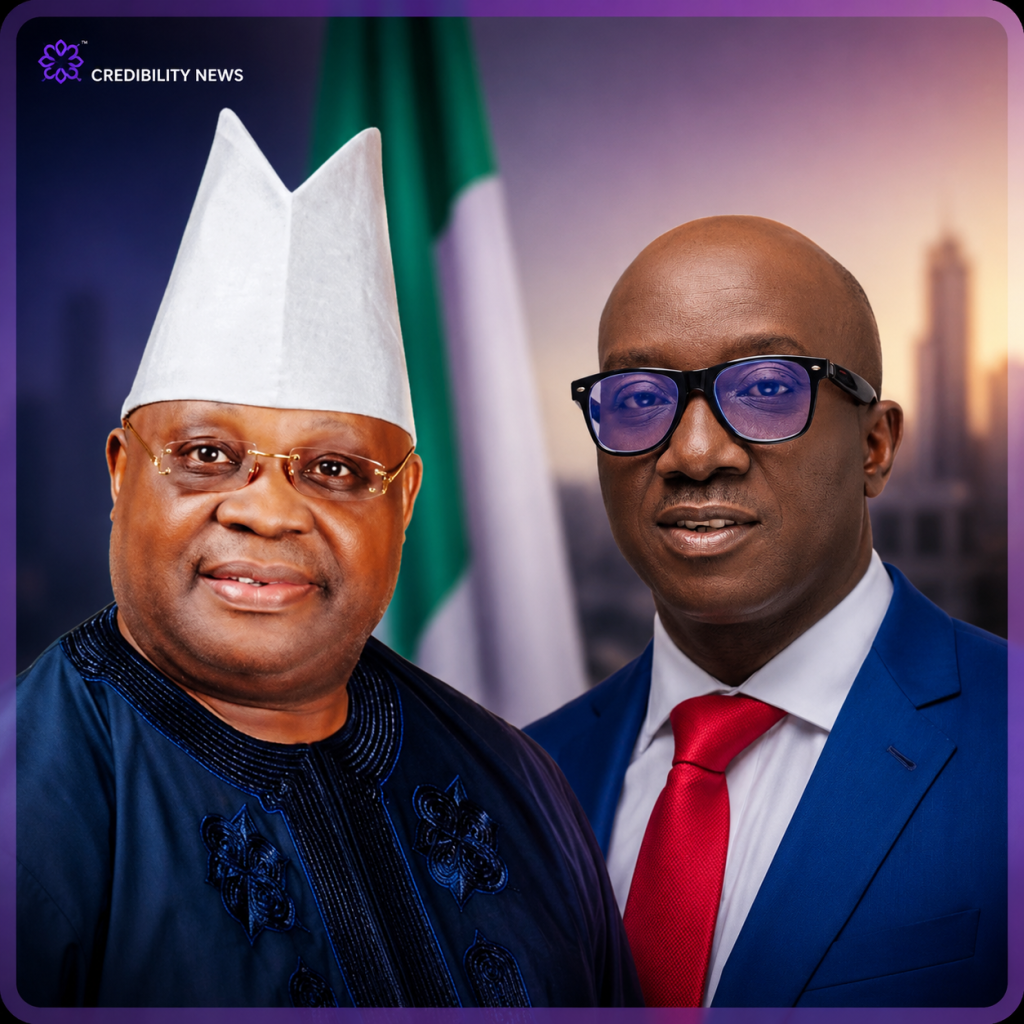
In Nigerian politics, words are not just tools of persuasion; they are weapons that can shape reputations, fracture alliances, and redefine the boundaries of public discourse. Governor Monday Okpebholo of Edo State has emerged as a striking example of this phenomenon. His style of criticism—direct, personal, and often dismissive—has drawn attention across the political landscape. From labelling the Osun State Governor, Ademola Adeleke, as a “dancing governor” to issuing threats against political opponents, Okpebholo’s rhetoric raises questions about the role of language in governance and the limits of political rivalry.
Governor Okpebholo’s jab at Governor Adeleke was not subtle. He mocked Adeleke’s penchant for dancing, saying that “the Governor dances and before he gets to their meeting, it’s over.” This remark, delivered in a political context, was more than a playful dig—it was a dismissal of Adeleke’s leadership style, reducing his persona to entertainment rather than governance. He went further to make a mockery of the roads in Osun, claiming that his car was “dancing” while driving into the state. Such rhetoric resonates with supporters who enjoy the spectacle, but it undermines the seriousness of inter-state collaboration. Roads in Osun, Okpebholo claimed, were “not motorable,” further painting Adeleke as a leader more concerned with performance than infrastructure.
Okpebholo did not stop at mocking Adeleke’s dancing and Osun’s roads. He also described Adeleke as “Obaseki’s friend” who should be voted out, urging Osun voters to reject Adeleke just as Edo voters rejected Obaseki. In his words, “That man is Obaseki’s friend. You know we kicked Obaseki out of Edo. So, we have to kick his friend out of this place too.” By tying Adeleke to Obaseki, Okpebholo sought to frame Adeleke’s leadership as an extension of what he considered failed governance in Edo, thereby escalating the rivalry beyond personal mockery into political delegitimisation.
Okpebholo’s remark about Adeleke is not an isolated incident. His political style is marked by sharp, confrontational statements that often target individuals rather than policies. At a rally in Uromi, Okpebholo warned that a political rival’s “security will never be guaranteed” if he entered Edo State without permission. This statement sparked outrage, raising constitutional concerns about freedom of movement and the right to political participation. He has also described the opposition PDP faction in Edo as “mad again,” trivialising their criticisms instead of engaging with substance. His directive to the Chief Judge to establish special courts for kidnapping cases was criticised as unconstitutional, reflecting a governance style that prioritises spectacle over due process.
Words spoken by a governor carry weight far beyond the immediate audience. They shape public perception, influence political alliances, and can even destabilise governance. Okpebholo’s style raises several risks. First, there is the erosion of decorum. Governors are expected to uphold mutual respect, even when disagreeing. Public ridicule undermines the dignity of office. Second, there are constitutional implications. Threatening the safety of political opponents contradicts Nigeria’s constitutional guarantees. Third, there is public distraction. Citizens may see such rhetoric as entertainment, diverting attention from pressing issues like healthcare, education, and infrastructure. Finally, there is long-term damage. Words cannot be taken back. They risk alienating allies and deepening political divisions.
Governor Okpebholo’s style diverges sharply from his peers. While Adeleke embraces populist theatrics and Obaseki focuses on policy, Okpebholo thrives on confrontation. His direct, confrontational rhetoric may energise supporters, but it risks undermining governance and eroding democratic norms. The “dancing governor” remark against Adeleke, his mockery of Osun’s roads, and his comparison of Adeleke to Obaseki exemplify this approach—entertaining, perhaps, but ultimately damaging.
Politics is not a rivalry sport; it is a platform for service. Criticism, when constructive, can strengthen democracy by holding leaders accountable. But when criticism becomes ridicule, it weakens institutions and erodes trust. Okpebholo’s style reflects a broader trend in Nigerian politics where spectacle often overshadows substance. His words may energise supporters, but they risk reducing governance to entertainment. In a country facing economic challenges, insecurity, and infrastructural decay, citizens deserve more than verbal sparring—they deserve solutions.
Nigerian politics has long been shaped by fiery rhetoric. From the populist speeches of governors in the First Republic to the confrontational style of military rulers, words have always played a central role. However, the democratic era demands a different approach—one rooted in respect, collaboration, and policy-driven debate. Okpebholo’s style harks back to an older tradition of political combat, but in today’s context, it feels out of step with the demands of governance. His remarks against Adeleke may entertain, but they do little to address the real issues facing Edo and Osun States.
As a governor, Okpebholo carries the responsibility of representing not just his party but his people. His words reflect on Edo State as a whole. When he ridicules a fellow governor, it is not just a personal attack—it is a statement about how Edo engages with other states. Leadership demands restraint. Words spoken in anger or jest can have lasting consequences. Governors must remember that their rhetoric shapes not only political discourse but also public trust.
Governor Okpebholo’s style of criticism sets him apart in Nigerian politics. His direct, confrontational rhetoric may energise supporters, but it risks undermining governance and eroding democratic norms. Politics is far deeper than rivalry. It is about service, collaboration, and respect. Governors must be careful with their choice of words, for words once spoken can never be taken back. Nigeria’s democracy deserves leaders who elevate discourse, not diminish it.
For comments, reflections, and further conversation, email samuelagogo4one@yahoo.com or call +2348055847364.