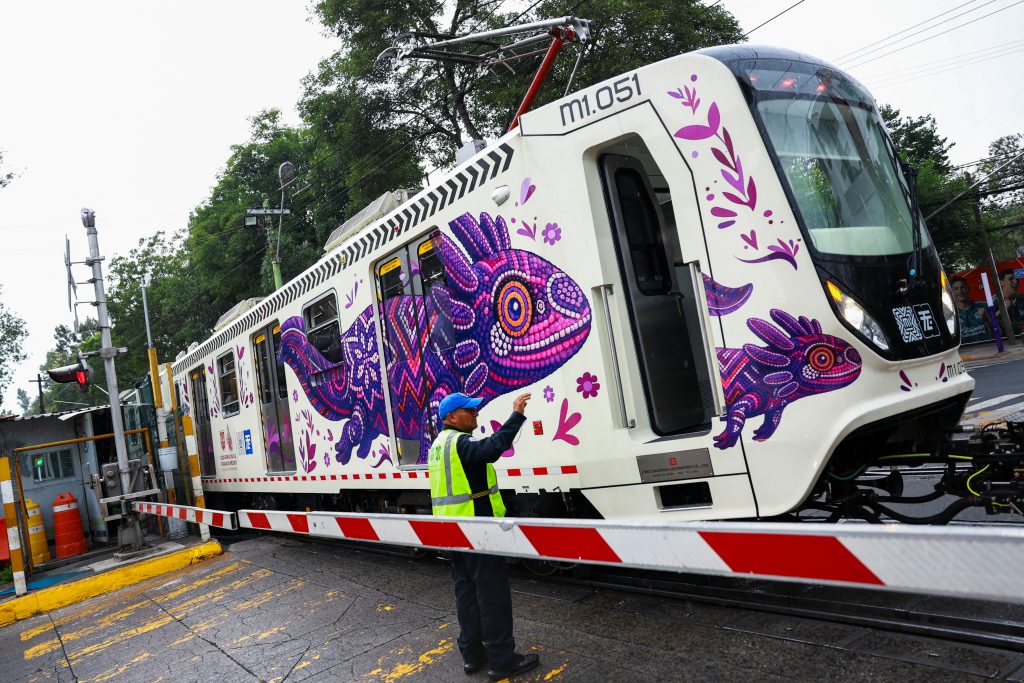
MEXICO CITY – One of the first things visitors arriving in Mexico City for the World Cup are likely to notice is the wide grin of an axolotl. The salamander, unique to this part of the world, has been splashed in bright purple across murals and subway cars, while sculptures depict it dribbling a football.
Named after the Nahuatl word for “water monster”, the axolotl (pronounced ah-sho-LO-tul) has become the unofficial mascot as the city prepares to host five World Cup matches, including Thursday’s opening fixture.
However, despite the undeniable appeal of the almost otherworldly amphibian, the widespread use of its image has sparked criticism from many Chilangos, as Mexico City residents are known. Critics argue that the cheerful portrayal of the critically endangered species is being used to distract attention from the capital’s infrastructure challenges and inadequate conservation efforts.
Scientists Fail to Find Wild Axolotls
Scientists attempting to count axolotls in the wild say they have not seen a single specimen in two years. A campaign against what has been dubbed “axolotlisation” has fuelled a wave of internet memes depicting Godzilla-like axolotls rampaging through the city.
Mexico City authorities did not respond to requests for comment.
Ernesto Velazquez, 19, who runs an axolotl-themed stall selling soft toys in Chapultepec Park, told Reuters that he hopes the newly painted images across the city will inspire greater interest in conservation.
“Some foreigners have asked whether you can eat them – well, no, they are at risk of extinction,” he said. “I hope the World Cup helps people learn more about them so we take better care of them.”
A Disappearing Habitat
For centuries, Ambystoma mexicanum – an amphibian that remains aquatic throughout its life – thrived among chinampas, farms built on artificial floating islands that once sustained the Aztec capital of Tenochtitlan, the site of present-day Mexico City.
The lake on which the city was built was largely drained during the colonial era, and what remains has been increasingly depleted and polluted by urban expansion.
The southern district of Xochimilco, famous for its maze of canals, colourful barges and rich folklore, remains one of the axolotl’s last refuges.
Staggering Decline
The National Autonomous University of Mexico (UNAM) recorded around 36 axolotls per square kilometre in Xochimilco in 2014, a dramatic fall from approximately 6,000 per square kilometre in 1998.
A new census began in 2024, and two years later researchers have yet to find a single axolotl during field surveys.
Vania Mendoza, who coordinated the census, said she and her team ventured onto the canals before dawn throughout the winter, attempting to capture and count axolotls in their nets.
Although none were found, water samples revealed traces of axolotl DNA, confirming that some individuals still survive in the canals. UNAM is expected to publish its findings later this summer.
“We know they’re there,” Mendoza said.
Football and Mass Tourism
Luis Zambrano, head of UNAM’s Ecological Restoration Laboratory, said that, alongside a constant flow of poorly treated wastewater, new threats include the conversion of chinampas into football pitches and increasing pressure from tourism.
Axolotls absorb oxygen through their skin, making them particularly vulnerable to polluted water.
“Mass tourism has become a terrible problem now with the World Cup,” Zambrano said. “The government thinks more is better, but that’s not true in areas of such high ecological value.”
Captive Breeding and Conservation Hopes
Even as their natural habitat shrinks, axolotls are widely bred in captivity. Scientists believe their remarkable ability to regenerate limbs, organs and even parts of their brain could hold valuable clues for cancer research and regenerative medicine.
Andres Huerta, 28, a pharmacist from Phoenix, Arizona, visiting during the World Cup, said he knew little about axolotls before arriving in Mexico City but was impressed by a large mural he saw near the airport.
“It’s really beautiful,” he said.
Outside Azteca Stadium, where the opening match will be played, a football-themed axolotl statue known as “Ajologol” was removed last month. Mayor Clara Brugada told reporters that large crowds stopping to take photographs had been causing congestion, but said the statue would soon be relocated nearby.
For ecologist Zambrano, however, the axolotl’s global popularity has yet to translate into meaningful action to protect its natural habitat.
“People prefer to see them in fish tanks,” he said.
Source: Reuters