There is a particular kind of joy that only comes after a very long wait.
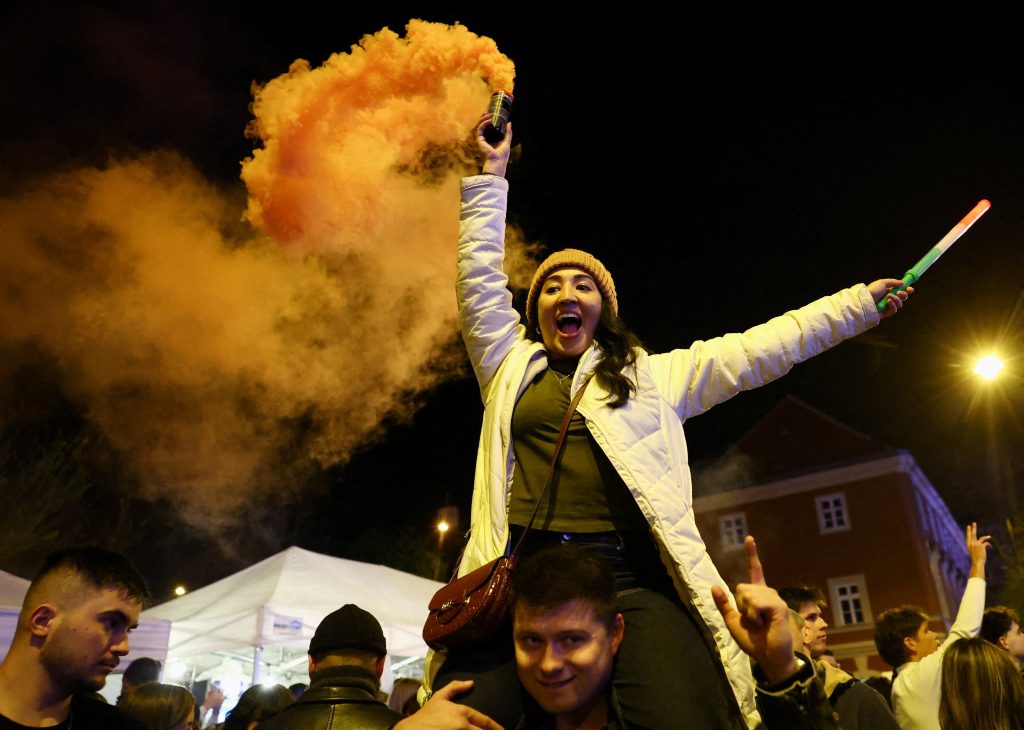
On Sunday night, Budapest did not go to sleep. Tens of thousands poured onto the embankment along the Danube, waving Hungarian and European Union flags, chanting on the metro, dancing outside pubs, and toasting with champagne in paper cups as the results came in. After 16 years, Viktor Orban was out.
The Tisza party’s sweeping victory, delivered on a record turnout of 80 percent, was not merely an election result. For those celebrating on the Chain Bridge, lit up in Hungary’s national colours, it felt like the country exhaling.
“I feel amazing. Really amazing. Like, I never thought this would actually happen. I’ve been praying for this for 16 years,” said Szilvia, a Tisza supporter, as crowds watched the victory speech from opposition leader Peter Magyar.
Elsewhere, chants of “it’s over” rang through the city’s metro carriages. Outside the parliament building, a rave went on until the early hours.
The scale of the moment was not lost on those who lived through it.
“Finally, after at least 16 years, we feel like there is hope,” one young reveller said. “Hope that Hungary can start walking in the right direction.”
That sentiment carried particular weight among younger voters, who had long since turned away from Orban’s Fidesz party. A survey by pollster Median put Fidesz support among 18 to 29-year-olds at just 8 percent.
It is a striking figure for a party that began life in the late 1980s as an opposition youth movement, and a telling one — the generation Fidesz was once built to represent had, by the end, become its sharpest critics.
For many Hungarians, this election was about more than domestic politics. It was a vote for the country’s place in Europe, and a rebuke of the democratic backsliding that critics say Orban systematically engineered since taking power in 2010.
Peter Magyar, the incoming leader, promised to govern for all Hungarians. The crowds in Budapest, at least, seemed ready to hold him to it.
Whether the celebrations outlast the morning is, of course, a different question. Sixteen years of consolidated power does not dismantle itself overnight.
But on Sunday, in a city that had waited a very long time for this, none of that seemed to matter yet.
Sources: Reuters, Median poll, Tisza party statements, Hungarian election results