BERLIN/BRUSSELS – The June heatwave that broke a series of temperature records in Europe has focused minds on the urgency of adapting to global warming in a continent once complacent about its relatively gentle climate and its ambitious goals on reducing emissions.
The European Union has sought to be a leader in addressing climate change and was one of the first major economies to set a legally binding target to reach net-zero emissions by 2050.
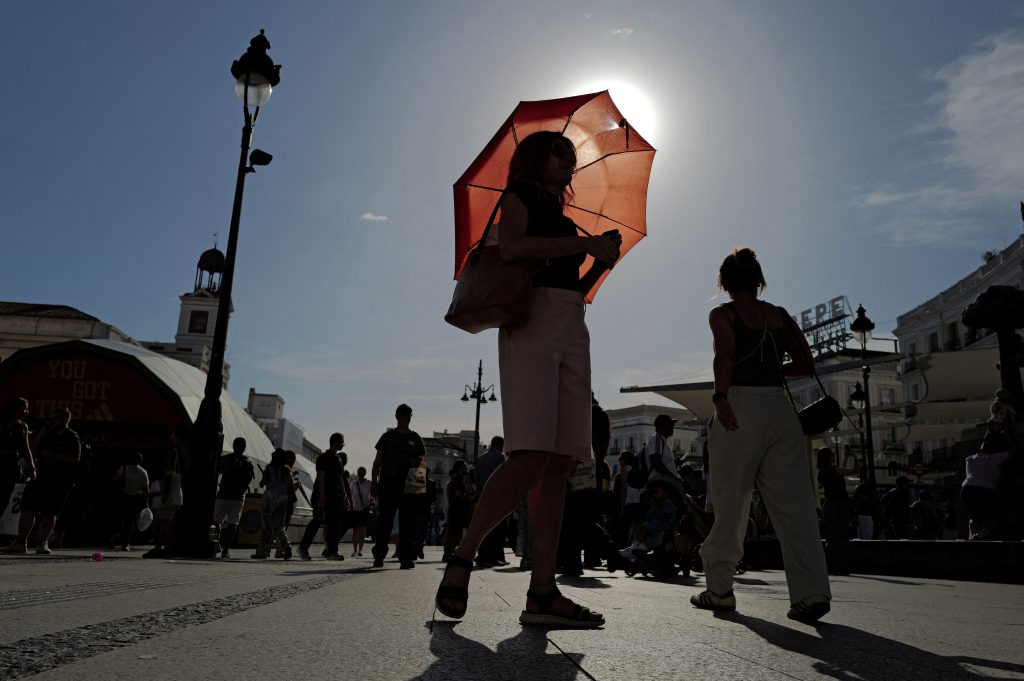
But a June heatwave that peaked at above 40 degrees Celsius (104 degrees Fahrenheit) in parts of Europe has revealed how its businesses, amenities, and critical infrastructure are not prepared for the consequences of climate change in the here and now.
“We’ve not been good enough on adaptation,” Poland’s Deputy Climate Minister Krzysztof Bolesta told Reuters after some power supplies across the region were disrupted, outdoor work was banned in places, trains were cancelled in Germany, and in Sweden a cargo train derailed as extreme temperatures buckled metal rails.
Among the countries worst affected, Spain reported 1,000 excess deaths that it linked to the record heat.
Adapting buildings and public spaces to cope with extreme heat is typically the responsibility of national or regional authorities, rather than the EU, which says individual countries are best placed to understand their particular needs.
“There’s no point in trying to say from Brussels how the Greeks or the Spaniards need to battle wildfires,” EU Climate Commissioner Wopke Hoekstra, who later this year will set out an EU-wide “climate resilience plan,” told journalists.
“They know that much better than we do as the Dutch know much better how to build dikes,” he said, adding the EU plan would focus on common scenarios and best practice.
Still, the EU’s own spending on adapting remains small, even as global warming is heating Europe at a faster rate than any other continent.
Between 2021 and 2025, 72% of the climate-related spending from the EU’s joint budget went to mitigation, or limiting the greenhouse gases that cause warming, while just 18% went to adaptation, and 9% touched both issues, official figures show.
The EU and its member governments have a suite of financial incentives in place to reduce emissions, including subsidies to build renewable energy, and the EU’s Emissions Trading System, which caps the emissions companies produce and lets greener firms trade at a profit their spare permits to pollute.
Poland’s Bolesta said that for businesses there was no equivalent encouragement to invest in adaptation measures.
“It’s easier to see the business case for mitigation, because you have the cap-and-trade system, you have carbon credits, you have renewables companies,” he said.
“Adaptation, it’s mostly regarded as a cost with very long-term benefits, so delayed gratification, but also sometimes just an insurance policy – it might or it might not kick in.”
Climate change-fuelled extremes like heatwaves, drought, and floods cost the near-stagnant European economy 0.3% points in output last year, Dutch bank ING said in a note this week.
“The uncomfortable truth is that heatwaves have quietly graduated from ‘weather event’ to ‘macro variable’,” ING said.
“The thermometer, it turns out, has become a leading indicator.”
The cost to economies ranges from threats to tourism or farming revenues in southern countries, to the difficulty of working in offices that are not adapted to hot weather.
Despite an official estimate that one day of heat above 30 degrees Celsius (86°F) costs the German economy €430 million ($465 million) due to productivity losses, only half of German offices are air-conditioned, according to the Federal Environment Agency, versus 90-95% in southern Europe.
“For decades, we (Germany) built against cold and not against heat and that’s an adaptation gap,” said Geraldine Dany-Knedlik from the German Institute for Economic Research DIW.
Irene Seemann, who heads efforts to help businesses with climate adaptation in the large German state of North Rhine-Westphalia, said there were signs of mindset change.
“To use a football analogy, Germany has been one-nil down because heat has not been much of an issue,” Seemann said. “Now companies see that it has a direct impact on their operations.”
Some adaptation fixes are simple and relatively cheap.
Forbidden by heritage laws from structurally altering its historic, glass-domed headquarters in Cologne, German flooring firm Project Floors applied reflective film to its windows and managed to lower indoor temperatures by 10 degrees Celsius.
“It was simple, effective, and required no power,” said Project Floors managing director Bernd Greve.
Others require more fundamental changes to workplaces and labour organisation, for example by rearranging work shifts to cooler times of the day, right through to reinventing public transport networks and urban spaces.
There has been progress compared with a deadly heatwave in 2003, when peer-reviewed studies have found around 70,000 excess deaths occurred over the summer in Europe.
The World Health Organization released a statement this week estimating that heat-related deaths in Europe, more than two decades later, would have been around 80% higher without the adaptation measures now in place. They include heat-health action plans, early warnings, cooling spaces, and outreach to vulnerable people.
“They are saving lives right now,” said the WHO’s regional director for Europe, Hans Henri P. Kluge. “We need more of them, across all of the European region.”
Source: Reuters