ABUJA, NIGERIA — A legal dispute surrounding the purported Presidential Foreign Intervention Promotion Council (PFIPC) has intensified public debate over government transparency after conflicting claims emerged regarding the agency’s existence, a budget allocation in the 2026 Appropriation Act, and criminal charges against a man who claims to have headed the body.
At the centre of the controversy is Prince Adeniyi Adeyemi Matthew, who has publicly maintained that he was appointed Director-General of the PFIPC, while the Presidency insists that no such agency exists and that the appointment documents he relied upon were forged.
The matter is now before the court.
How One Man Allegedly Secured an Appointment That Never Existed
According to petitions and public statements made by Adeyemi, he alleges that he made substantial payments in connection with securing the appointment and has accused senior government officials of involvement in the process. Among those he has named is the President’s Chief of Staff, Femi Gbajabiamila.
The Presidency has categorically denied the allegations.
In a statement issued by Presidential spokesman Bayo Onanuga, the Presidency described Adeyemi as an impostor who allegedly forged appointment letters and falsely presented himself as the head of a non-existent government agency.
The statement further alleged that Adeyemi operated from office space within the Federal Secretariat, organised meetings with diplomats and government officials, and opened multiple bank accounts linked to fictitious government entities.
The Presidency also stated that the Office of the Chief of Staff has no constitutional or statutory authority to create federal agencies or make appointments outside established government procedures.
Adeyemi has denied the forgery allegations and insists that his appointment was genuine.
Budget Allocation Raises Troubling Questions
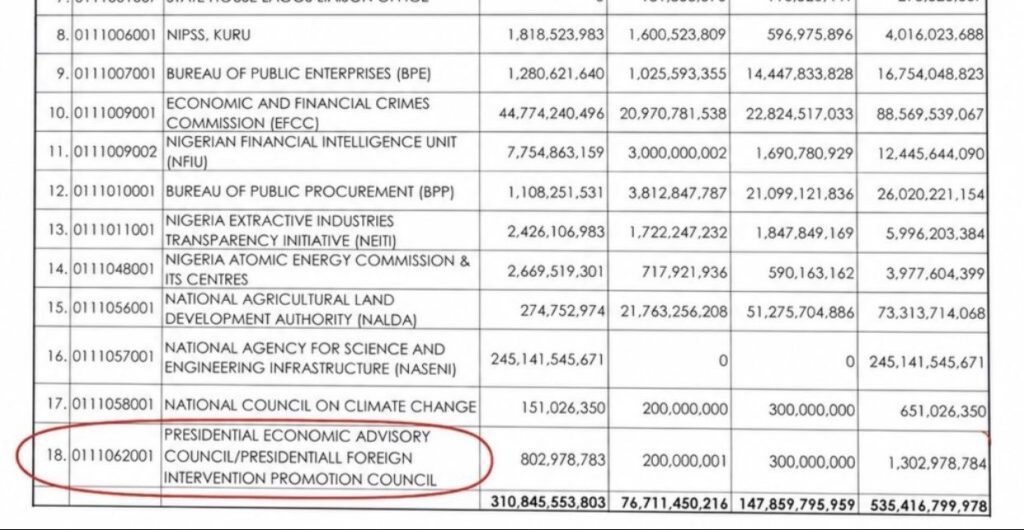
A key issue attracting public attention is the inclusion of a budget line in the 2026 Appropriation Act referring to the Presidential Economic Advisory Council/Presidential Foreign Intervention Promotion Council.
The approved budget lists Budget Code 0111062001 under the Presidency with a total allocation of ₦1,302,978,784, comprising:
- Personnel Costs: ₦802,978,784
- Overhead Costs: ₦200,000,000
- Capital Expenditure: ₦300,000,000
The inclusion of the budget allocation has prompted questions from legal observers and public finance analysts about how an agency publicly described by the Presidency as non-existent came to appear in the national budget.
The Presidency’s public statements denying the existence of the agency have not specifically addressed the budget allocation contained in the Appropriation Act.
It remains unclear whether the budget entry resulted from an administrative error, a legacy budget item, a proposed agency that was never legally established, or another explanation.
How Did ₦1.3 Billion Find Its Way Into the Budget?
The presence of the PFIPC in the 2026 Appropriation Act raises fundamental questions about Nigeria’s budget process integrity:
| Question | Status |
| Who submitted the PFIPC budget proposal to the Budget Office? | Unanswered |
| How did the entry survive multiple review checkpoints? | Unanswered |
| Have any funds been released against this allocation? | Presidency claims no funds were transferred |
| Has the allocation been formally cancelled? | Unconfirmed |
Political analyst Olufemi Awoyemi noted that a budget line “does not emerge from nowhere”—it must pass through multiple institutional gates including the Budget Office of the Federation, the Federal Executive Council, and the National Assembly.
Criminal Proceedings Underway
Federal authorities have charged Adeyemi with offences including alleged forgery and impersonation.
Key details from court documents obtained by Credibility News:
- Charges filed on November 27, 2025
- Eight-count charge filed at the Federal High Court, Abuja
- 11 witnesses listed, including the Chief of Staff and civil servants posted to Adeyemi’s office
- Hearing scheduled for July 27, 2026
- 34 bank accounts linked to Adeyemi were recovered by police, including nine opened in the names of purported government agencies
Under Nigerian law, Adeyemi is presumed innocent unless and until proven guilty by the court.
He has rejected the allegations against him and has maintained that official records, correspondence and other documentary evidence support his position.
The Strange Death of a Key Figure
Public attention has also focused on the death of Dolapo Babatunde Tanimola, whom Adeyemi has identified as an important figure in the events surrounding the disputed appointment.
According to publicly available reports, Tanimola died in a hotel fire at Kachi Hotel in Utako, Abuja, in October 2025.
Credibility News has not found official evidence linking the hotel fire to the ongoing court case, and no law enforcement agency has publicly stated that the death was connected to the dispute surrounding the PFIPC.
However, the timing—with Tanimola’s death occurring months before the controversy became public—has fuelled speculation that has yet to be addressed by authorities.
Questions That Demand Answers
As legal proceedings continue, several questions remain unanswered:
- Why does the 2026 Appropriation Act contain a budget allocation for the Presidential Foreign Intervention Promotion Council if the agency does not legally exist?
- How was the budget entry processed through the executive and legislative budget approval process?
- What administrative processes, if any, authorised the agency’s activities?
- Who within the government facilitated Adeyemi’s access to Federal Secretariat office space?
- How was he able to open bank accounts in the names of purported government agencies without proper documentation?
- What evidence will prosecutors and the defence present during the court proceedings regarding the authenticity of the appointment documents?
- Has the government taken steps to deactivate the MDA code and cancel the budget allocation?
- What oversight mechanisms failed to prevent this situation, and what reforms will prevent a recurrence?
A Governance Scandal Unfolds
The PFIPC controversy represents more than a case of alleged impersonation. It exposes potential weaknesses in Nigeria’s budget approval process, institutional oversight, and inter-agency coordination.
Atiku Abubakar, former Vice President of Nigeria, framed this as evidence of a government “held hostage by fraudsters” operating from within state institutions, suggesting that the scandal reflects deeper governance failures.
The Civil Society Coalition for Truth and Justice has submitted nine questions demanding clarity from the Presidency, including who facilitated the agency’s recognition and what measures have been taken to prevent similar occurrences.
What Happens Next?
The answers to the outstanding questions are likely to emerge through:
- The ongoing judicial process, with the first hearing scheduled for July 27, 2026
- Any future official investigations by anti-corruption agencies
- Oversight hearings by the National Assembly
For now, Nigerians are left with a troubling reality: a non-existent agency secured office space in a federal building, opened bank accounts, and obtained a budget allocation exceeding ₦1.3 billion—all while the government claims it never existed.
Credibility News will continue to monitor the proceedings and publish updates as new evidence becomes available.