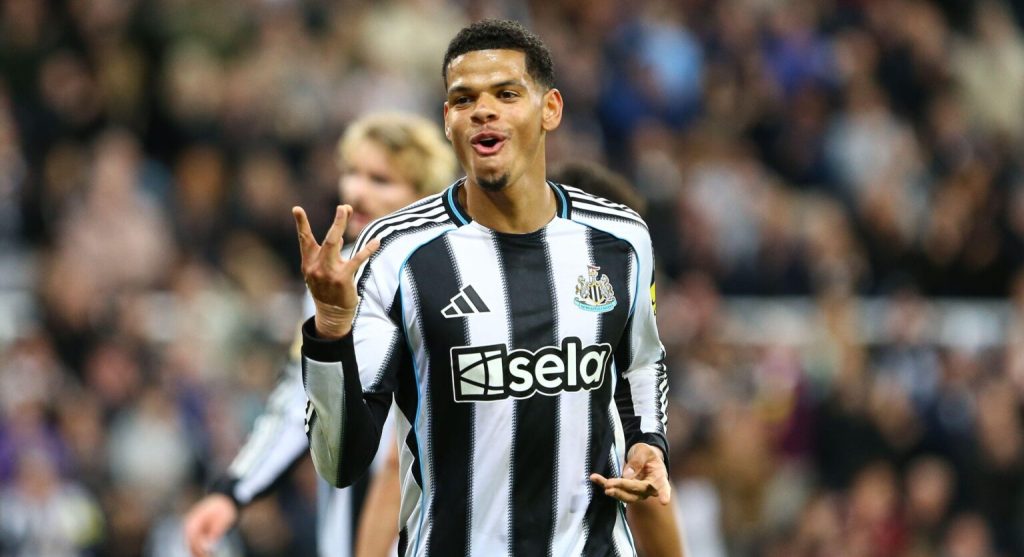
The Nigeria Football Federation have stepped up their efforts to strengthen the Super Eagles attack, making contact with William Osula over a potential international switch from Denmark to Nigeria.
The Newcastle United striker, born in Copenhagen to a Danish mother and Nigerian father, has represented Denmark at youth level but remains uncapped at senior level—keeping the door open for a change of allegiance.
Nigeria’s approach, made between April 23 and 24, was deliberate and driven from the top. Super Eagles head coach Eric Chelle was directly involved in discussions with Osula’s representatives, signalling the federation’s serious intent to secure the 22-year-old’s commitment.
Chelle is understood to view Osula as a key component in building a younger, more dynamic attacking unit ahead of the 2027 Africa Cup of Nations and beyond.
Osula, born on August 4, 2003, in Aarhus, has impressed at youth level for Denmark, scoring eight goals in 15 appearances for the under-21 side after progressing from the U-19s.
Denmark head coach Brian Riemer recently praised the striker’s qualities.
“He has exceptional top-level skills with his speed, and his pressing game is outstanding. He brings something that can change matches,” Riemer told TV 2.
Osula joined Newcastle United from Sheffield United in August 2024 in a deal worth up to £15 million. Manager Eddie Howe highlighted his pace and potential as key attributes at the time of signing.
After initially struggling for consistent minutes, the forward has recently begun to make an impact, with improved performances in the Premier League raising his profile at both club and international level.
Despite receiving a senior call-up from Denmark in March 2026 for World Cup qualifiers against North Macedonia and the Czech Republic, Osula did not feature—leaving him eligible to switch national teams under FIFA regulations.
According to FIFA rules, players who have only represented a country at youth level may file a one-time switch, provided they have not been cap-tied at senior level—placing Nigeria in a strong position to pursue his commitment.
Nigeria’s renewed push for diaspora talent comes as part of a broader rebuilding strategy following their failure to qualify for the 2026 FIFA World Cup. The federation is also preparing for the Unity Cup in London, along with international friendlies against Poland and Portugal.
Chelle has emphasised the need to widen the talent pool, combining domestic scouting with outreach to Nigerian-heritage players abroad as the Super Eagles look to rebuild toward 2027 and beyond.
Competition for attacking places remains intense, with established names such as Victor Osimhen, Ademola Lookman and Akor Adams already in the fold. However, Osula’s profile—defined by pace, physicality and pressing ability—offers a different tactical dimension.
For Nigeria, the pursuit of Osula is about more than recruitment; it reflects a long-term vision to build a younger, competitive squad capable of challenging on the global stage.
For the player himself, the decision goes beyond football.
Having grown up between Danish culture and Nigerian heritage, Osula now faces a defining choice—one that could shape not only his international career, but also his identity on the world stage