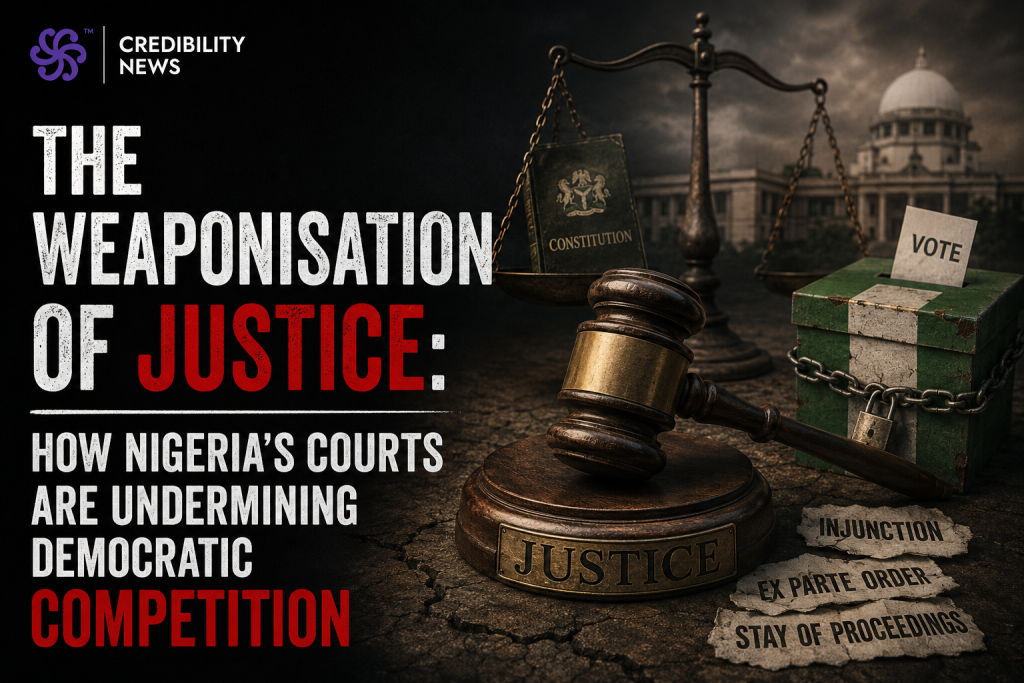
I have watched Nigerian democracy survive military threats, electoral fraud and the worst instincts of its political class. What I did not expect to be writing about in 2026 is the systematic use of our own courts to dismantle political competition before a single vote is cast.
The Federal High Court’s ruling of 26 June, stripping the Nigeria Democratic Congress (NDC) of its registration, is not a mere procedural matter. It is a warning—and Nigeria must heed it.
Since 1999, Nigeria has maintained an uninterrupted democratic tradition: imperfect, contentious and frequently bruised, but unbroken. Twenty-seven years of successive civilian administrations have been navigated without a single soldier walking into Aso Rock uninvited. That is no small achievement. On a continent that has witnessed democracy collapse in Mali, Burkina Faso, Niger, Guinea, Gabon and Sudan, Nigeria’s democratic record represents a precious inheritance. It is an inheritance now being frittered away—not by tanks, but by gavels.
The ruling by Justice Isah Dashen set aside an earlier judgment directing the Independent National Electoral Commission (INEC) to register the NDC. The court held that the original decision was procedurally defective because the Peace Movement Party (PMP) had not been heard. On the face of it, that appears to be a principled position.
However, the NDC maintains that the Peace Movement Party is not even a registered political entity in Nigeria. According to the party, the PMP was neither among the 18 registered political parties when the original suit was filed nor among the 171 associations that applied to INEC for registration. If that claim is correct, then the court has vacated a legitimate judgment, at one of the most consequential moments in the pre-election calendar, on the application of an entity that may not legally exist. That is not due process. That is judicial theatre.
The timing of the ruling is impossible to ignore. It came on the very day INEC was expected to open its portal for candidate nominations. NDC lawmakers have described it as a judicial coup, and it is easy to understand why they have used such language. A coup does not necessarily require soldiers. When the judiciary is used to achieve what elections might not, the effect can resemble other forms of democratic subversion.
This is not about loyalty to one political party. It is about loyalty to the principle of political competition. Democracy thrives on choice. A multi-party system in which opposition parties are eliminated through judicial manoeuvres is not democracy at all. It is the performance of democracy—a stage play in which the ending has already been written before the curtain rises.
The danger of this weaponisation of justice is not abstract. It strikes at the very heart of Nigeria’s political future. If courts can be used to silence opposition before ballots are cast, elections risk becoming hollow rituals. Citizens are asked to participate in a process whose outcome has effectively been determined in advance. That is not democracy. That is deception.
Judges who participate in such rulings should recognise that their robes do not absolve them of accountability. The Bench is not a sanctuary from civic responsibility. History records everything. The names of judges who deliver decisions that shrink the democratic space will be remembered. The names of those who institute politically strategic legal actions will also be remembered. Their legacies will endure.
Responsibility, however, does not rest with judges alone. Community leaders—traditional rulers, ward elders and religious councils—must recognise that silence in the face of democratic sabotage amounts to complicity. Religious bodies such as the Christian Association of Nigeria (CAN), Jama’atu Nasril Islam (JNI), the Catholic Bishops’ Conference of Nigeria and the Pentecostal Fellowship of Nigeria should call this what they believe it to be. To remain silent is, in the author’s view, to betray the covenant between governors and the governed.
No Nigerian who loves this country wants to see the military return to power. Yet military interventions rarely occur in a vacuum. They often arise when civilian leaders so thoroughly discredit democracy—through electoral manipulation, judicial interference and the silencing of opposition—that citizens lose faith in the democratic process. That is not a justification; it is a recurring historical pattern. Nigeria, the author argues, is moving dangerously close to repeating it.
This is not the first time Nigeria’s judiciary has faced accusations of narrowing the democratic space. In 2003, several opposition parties challenged the presidential election results, only for their petitions to be dismissed on technical grounds. In 2019, the Supreme Court’s decision that removed Emeka Ihedioha as Governor of Imo State and declared Hope Uzodinma governor was widely criticised by some observers as judicial overreach. In 2020, INEC deregistered 74 political parties, citing poor electoral performance, and that decision was subsequently upheld by the courts. According to critics, each of these episodes weakened political pluralism and reinforced the perception that the courts could be used as instruments of political convenience.
Nigeria is not alone in confronting these challenges. In Kenya, the judiciary has at times been viewed both as a guardian and as a source of political controversy. The Supreme Court’s annulment of the 2017 presidential election was widely praised as an assertion of judicial independence, while later decisions attracted criticism from some quarters. In Ghana, the judiciary has generally maintained public confidence, particularly during the presidential election petitions of 2012 and 2020, where despite intense political disagreement, the courts were largely regarded as impartial arbiters. South Africa’s Constitutional Court has frequently acted as a constitutional check on executive power, reinforcing democratic norms. By contrast, critics argue that Nigeria’s judiciary risks being perceived as an instrument of political suppression rather than a guardian of democracy.
To safeguard Nigeria’s democracy, the author contends that urgent reforms are required. Judicial appointments should be insulated from political influence through transparent processes that prioritise merit and integrity. Electoral disputes should be heard and concluded well before critical nomination deadlines to avoid judgments that coincide with key stages of the electoral calendar. Civil society should continue to advocate constitutional reforms that establish clear and objective criteria governing the registration and deregistration of political parties. INEC should also be strengthened, with its independence protected both in law and in practice. Above all, Nigerians should remain vigilant and resist reducing democracy to mere performance.
The judiciary must remember its constitutional role as the guardian of democracy, not its executioner. INEC must resist being drawn into judicial contests that undermine public confidence in the electoral process. Civil society must continue to speak out whenever the democratic space is perceived to be shrinking. And ordinary Nigerians must refuse to accept a democracy that exists only in appearance.
Democracy is not a gift bestowed by those in power. It is a right that belongs to the people. No court order, however elegantly drafted, can extinguish that right in the hearts of citizens determined to exercise it. Nigeria’s democratic inheritance is too precious to be squandered through judicial complicity. The robe must never become a weapon.
For comments, reflections and further conversation:
Email: samuelagogo4one@yahoo.com
Telephone: +234 805 584 7364