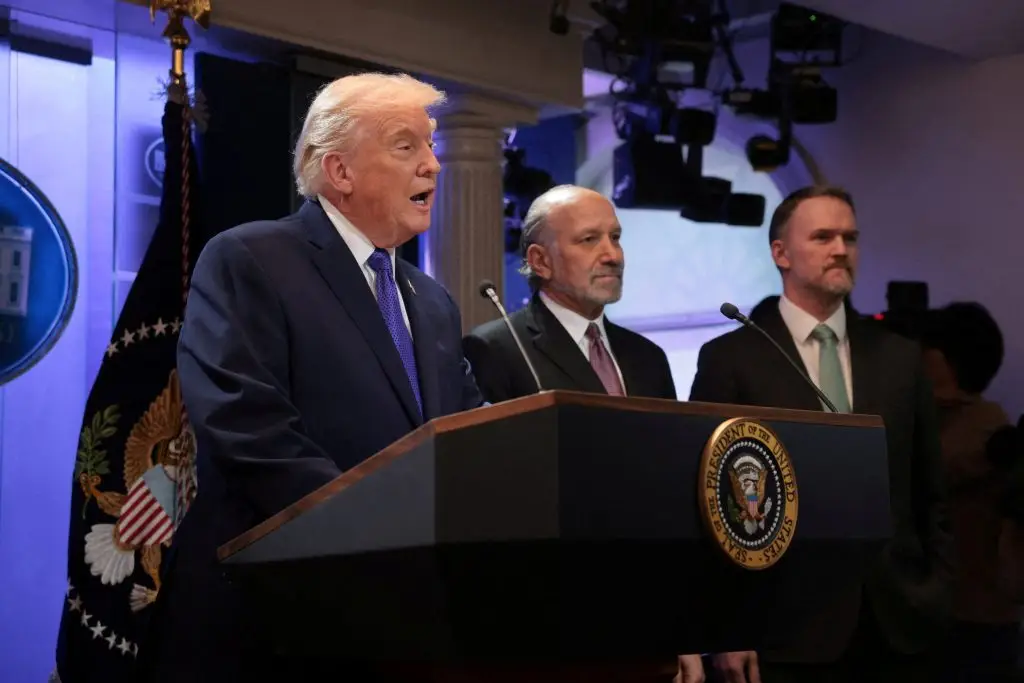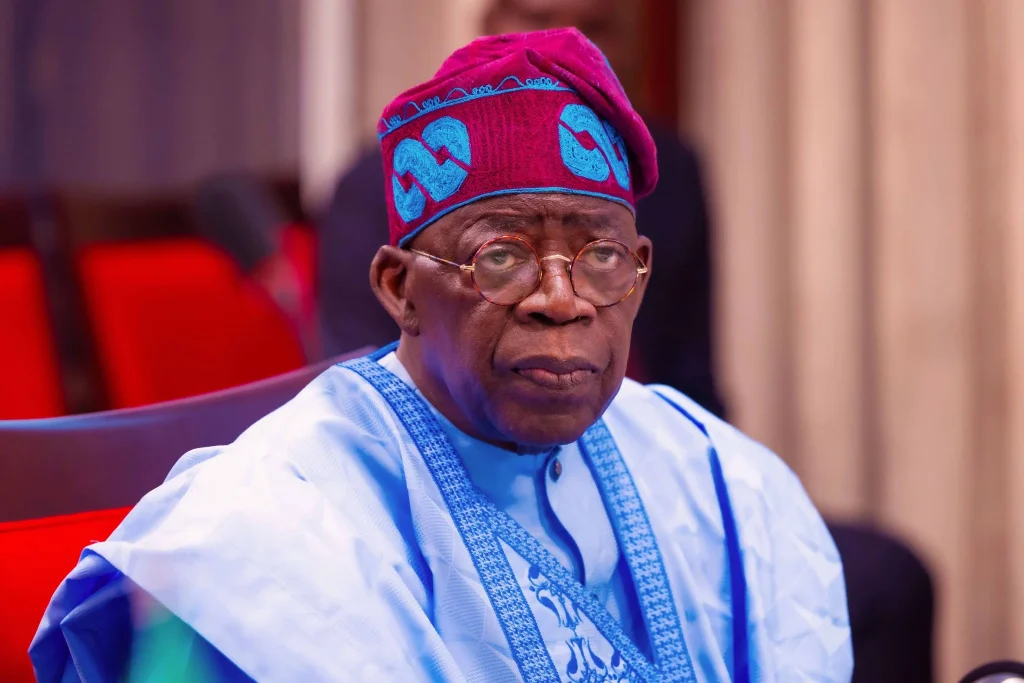
Nigerian President Bola Ahmed Tinubu has asked a United States federal court to reject a request seeking the release of law-enforcement records concerning him, arguing that the records contain private information protected from disclosure.
The position is set out in a 16-page court filing submitted on behalf of Intervenor Bola Ahmed Tinubu before the United States District Court for the District of Columbia in Aaron Greenspan v. Executive Office for U.S. Attorneys, et al., Civil Action No. 23-1816 (BAH).
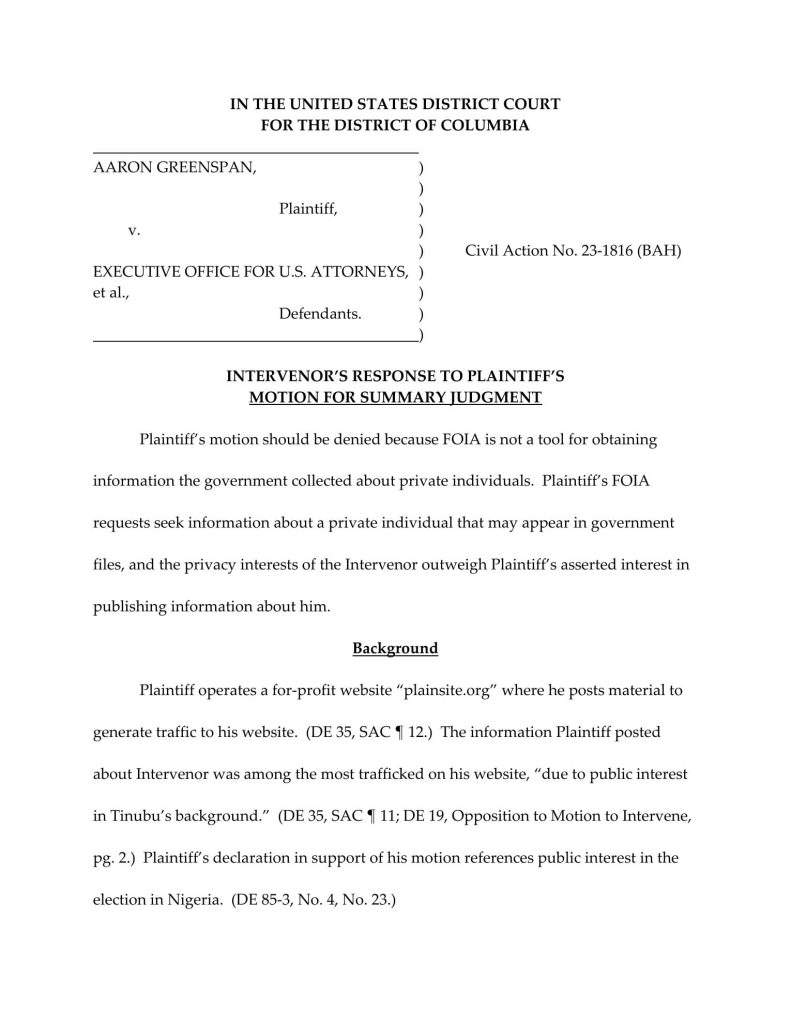
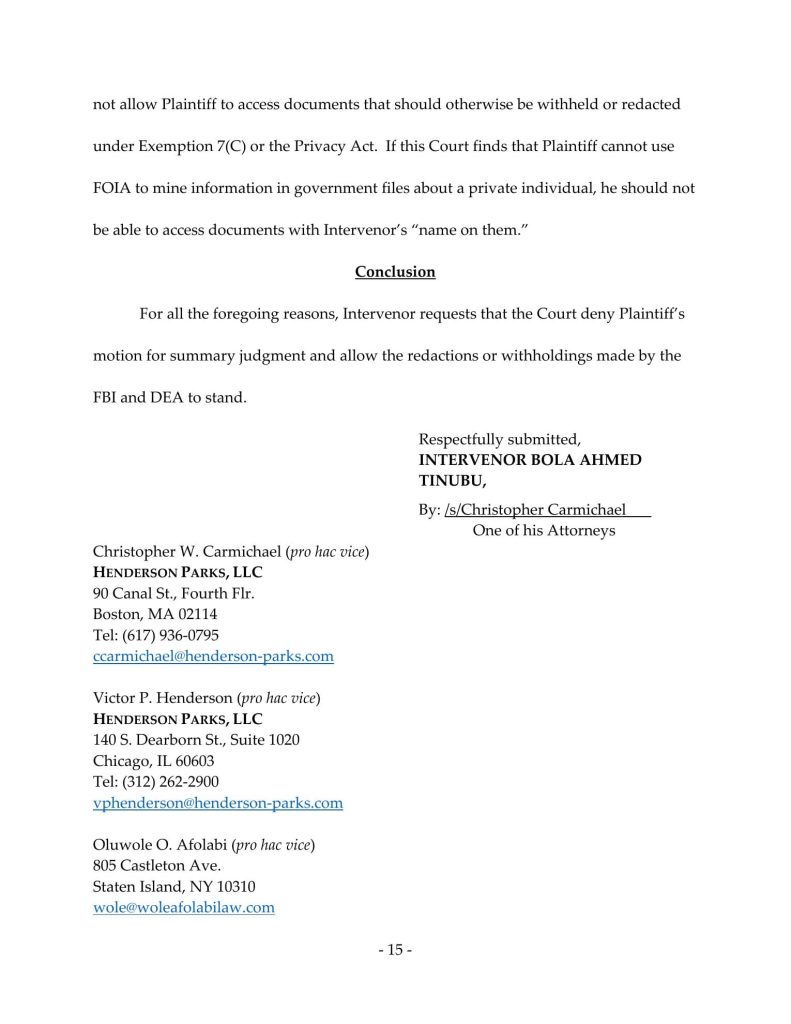
The document, titled “Intervenor’s Response to Plaintiff’s Motion for Summary Judgment,” asks the court to deny the plaintiff’s motion and to allow the redactions and withholdings by the Federal Bureau of Investigation (FBI) and Drug Enforcement Administration (DEA) to stand.
The filing was signed by Tinubu’s attorneys, including Christopher W. Carmichael, Victor P. Henderson, and Oluwole O. Afolabi of Henderson Parks, LLC.
FOIA Requests for Tinubu Records
According to the filing, plaintiff Aaron Greenspan submitted 12 Freedom of Information Act (FOIA) requests to several US government agencies, including the Department of Justice, FBI, Internal Revenue Service, CIA, and DEA, seeking records concerning Tinubu and his associates.
One of the FBI requests sought “the entire FBI file for Bola Ahmed Tinubu”. Another requested “FBI 302 interviews with Bola Tinubu from FBI Case No. 245-IP-71386-UUUUUU during the timeframe 1992-1993”.
The filing states that, following the agencies’ initial responses, eight requests involving the CIA, FBI, and DEA remained in dispute.
The court had previously ruled that the CIA’s so-called Glomar response — in which an agency neither confirms nor denies the existence of records — was proper, but found the FBI and DEA responses improper.
The court consequently directed the FBI and DEA to search for and process non-exempt records.
According to Tinubu’s filing, the FBI and DEA subsequently produced thousands of documents, some containing redactions, together with a Vaughn index identifying withheld material.
Tinubu’s Lawyers Cite Privacy
Tinubu’s legal team argues that the remaining information should not be disclosed because it concerns an individual’s private information contained in law-enforcement files.
The filing relies on FOIA Exemption 7(C) and the US Privacy Act, arguing that information about individuals collected by federal law-enforcement agencies can be withheld where disclosure would constitute an unwarranted invasion of personal privacy.
The lawyers distinguish between the privacy interest in keeping secret the fact that someone was investigated and the separate privacy interest in the contents of investigative files.
They argue that Tinubu retains a privacy interest in the contents of any investigative records concerning him, even where some information about him may already have appeared in public records.
Filing Refers to “Criminal Records” and Nigerian Election Enters the Legal Dispute
One of the most significant passages in the filing states that the plaintiff’s FOIA requests are intended to uncover “criminal records of an individual” and use those records to “influence politics in a foreign nation”.
Tinubu’s lawyers argue that neither an interest in an individual’s possible criminal records nor an attempt to influence politics in another country constitutes a “public interest” recognised under FOIA.
The filing also acknowledges that the plaintiff has cited the Nigerian public’s interest in Tinubu’s background and fitness for office.
It quotes the plaintiff as describing the case as involving “the sitting President of Nigeria”, whose decisions affect the lives of more than 230 million people.
Tinubu’s lawyers, however, argue that a general public interest in an individual’s background does not satisfy the public-interest test under US FOIA law.
The filing explicitly references the Nigerian election.
According to the document, the plaintiff’s submissions cited public interest in the election in Nigeria and Tinubu’s fitness for office.
Tinubu’s lawyers argue that the desire to obtain information about an individual in order to influence politics in a foreign country is not a public interest that FOIA recognises.
The filing further argues that the purpose of FOIA is to provide transparency about the activities of government agencies, rather than to disclose private information about individuals merely because that information happens to be held by the government.
Lawyers Reject Claims of Secret Prosecution and FBI Seeks to Submit Records Privately
Tinubu’s legal team also addresses suggestions by the plaintiff that there may have been a hidden criminal prosecution or a secret agreement not to prosecute.
The lawyers describe such suggestions as unsubstantiated, arguing that allegations of government wrongdoing must be supported by evidence.
The filing says the plaintiff has not produced evidence sufficient to establish that government misconduct occurred or to meet the legal threshold for obtaining private information contained in law-enforcement records.
Earlier this month, the FBI asked the court for permission to submit sensitive information privately and under seal to explain its decision to withhold portions of the requested records.
The agency said some of the information was protected under FOIA exemptions covering privacy, confidential sources, law-enforcement techniques, and information whose disclosure could reasonably be expected to endanger an individual’s life or physical safety.
The FBI invoked Exemptions 6, 7(C), 7(D), 7(E), and 7(F) regarding the requests.
The agency stated: “The FBI has determined that it cannot provide on the public record the full basis for the application of Exemptions 7(E) and 7(F) to certain withholdings and that, therefore, an ex parte, under seal declaration is necessary”.
An ex parte, in camera filing means the judge can examine the material privately rather than requiring it to be filed openly on the court docket.
What the Filing Establishes
The court document establishes that:
- FOIA requests were made for records concerning Tinubu and his associates
- the FBI and DEA were directed to search for and process non-exempt records
- thousands of documents were subsequently produced, some with redactions
- Tinubu formally intervened in the case
- his lawyers are opposing further disclosure of the remaining records
- his legal team is relying on privacy protections under US law
- the filing refers to the plaintiff’s objective as including obtaining “criminal records of an individual” and using them to influence politics in a foreign nation
The filing does not state that Tinubu admitted to heroin trafficking, nor does it establish that he was convicted of or engaged in heroin trafficking.
The specific reference to “criminal records” in the filing describes the nature of the information the plaintiff is alleged to be seeking. It should not be presented as an admission by Tinubu that he committed a crime.
Lobbying Firm Publicises Development and Case Background
The latest development was also highlighted by Von Batten-Montague-York, L.C., a Washington-based policy advisory and lobbying firm, on its X account (@batten_von).
In its update, the firm claimed that Tinubu had asked the court not to order the release of the records and argued that his position amounted to an attempt to keep the alleged records private. Those characterisations are the firm’s; the court filing itself provides the underlying legal arguments and requests.
The case stems from a FOIA lawsuit filed by American transparency activist Aaron Greenspan in 2023 against several US government agencies.
Greenspan’s requests date to 2022 and 2023 and included records concerning a historical investigation dating to the late 1980s and early 1990s.
The case also concerns records linked to a 1993 civil forfeiture proceeding in the US involving about $460,000 associated with Tinubu.
In April 2025, US District Judge Beryl Howell ruled that the FBI and DEA could no longer rely on Glomar responses, ordering them to process nonexempt records responsive to Greenspan’s requests.
The ruling did not establish that Tinubu committed a drug-trafficking offence or amount to a criminal conviction against him.
The court has yet to determine whether the remaining records must be released or may lawfully remain withheld.
The Credibility News will continue to follow the US court proceedings and report further developments based on verified court filings and rulings.