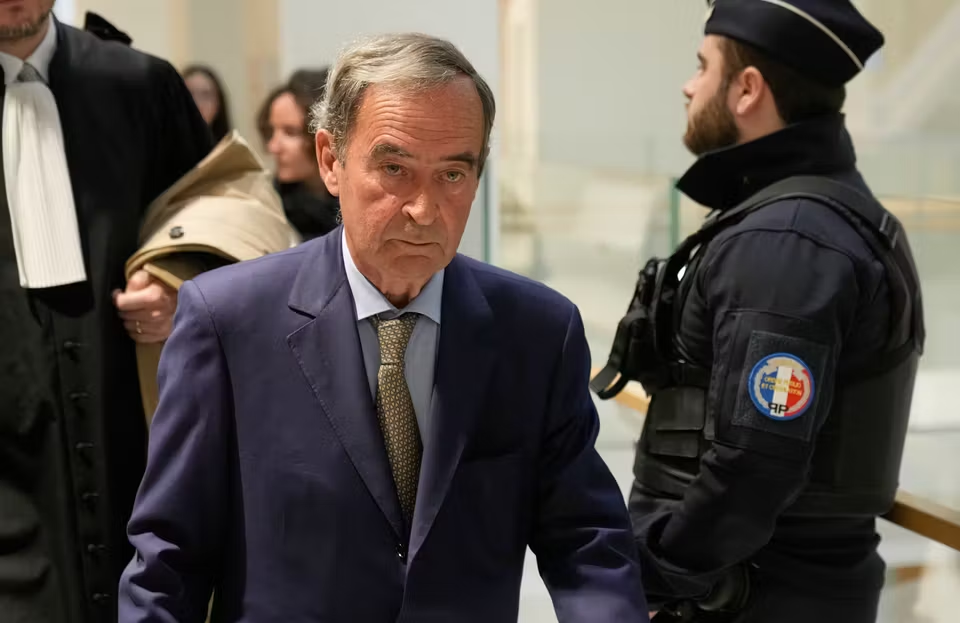
A Paris court on Monday found cement maker Holcim’s Lafarge unit guilty of charges that its Syrian subsidiary financed terrorism and breached European sanctions, in the first case in France against a company for financing terrorism.
Eight former employees were found guilty, with some sentenced to jail time — including former CEO Bruno Lafont, who received six years. His lawyer said he would appeal.
The company was ordered to pay a $1.32 million fine, the maximum available under French law.
Lafarge said it acknowledged the court’s findings and that the decision was an “important milestone” in its actions to “address this legacy matter.”
How Lafarge Funded Terrorist Groups
Judges said Lafarge paid over $6.5 million to Islamic State and the al-Qaeda-affiliated Nusra Front from 2013 to September 2014. Both are designated as terrorist groups by the European Union.
Presiding judge Isabelle Prevost-Desprez said the payments helped strengthen jihadist groups that carried out deadly attacks in Syria and beyond.
“The payments,” she added, “took the form of a genuine commercial partnership with the Islamic State.”
The court heard that Lafarge had breached European sanctions to keep a plant operating in northern Syria during the country’s civil war. Some payments were for safe passage of employees to the Jalabiya plant. Others were to purchase source materials from quarries under Islamic State control.
A Landmark Verdict
Claire Tixeire, co-director of the European Center for Constitutional and Human Rights — one of two groups that filed the case — called the verdict a “monumental warning.”
“This is a monumental warning to the entire community of multinational corporations that benefit from armed conflicts around the world,” Tixeire said. “That’s why it’s such a significant warning, and we hope there won’t be so much business as usual after this decision.”
The case marks the first time a company has been tried in France for financing terrorism. Legal experts say the verdict could have far-reaching implications for multinational corporations operating in conflict zones.
Who Was Convicted
| Individual | Role | Sentence |
| Bruno Lafont | Former CEO | 6 years in jail |
| 7 other former employees | Various roles | Jail time (lengths not specified) |
Holcim, the parent company, did not immediately respond to a request for comment.
Why This Matters
The verdict sends a clear message to multinational corporations: operating in conflict zones does not exempt companies from accountability for financing terrorist groups.
For years, human rights groups have documented cases of companies paying protection money or making deals with armed groups to keep operations running. This verdict suggests that such arrangements can now lead to criminal convictions.
Lafarge’s case is being watched closely by corporations operating in conflict zones around the world, including in parts of Africa, the Middle East and Asia.
Sources: Reuters, Paris court ruling, European Center for Constitutional and Human Rights