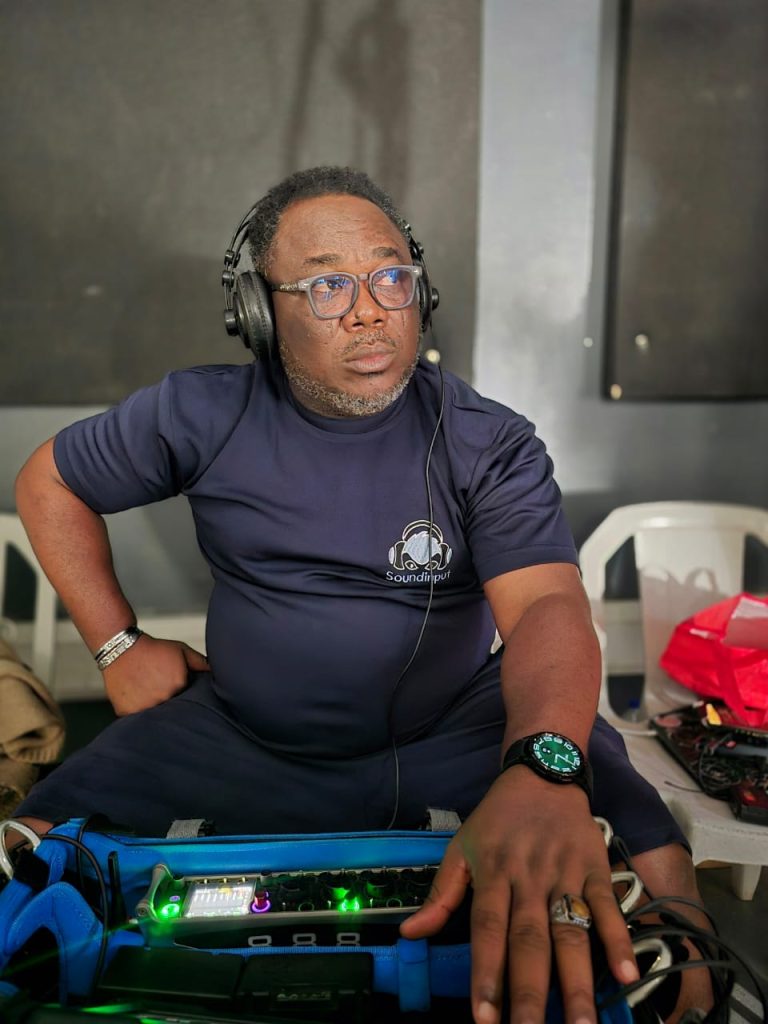
From growing up in a modest family of six to leaving the Polytechnic rather than joining a cult, Pius Fatoke has built a career spanning more than two decades as a sound professional in Nigeria’s film and television industry. In this conversation with Kingsley Akam, he discusses his journey, self-education, the struggle for recognition of technical professionals, remuneration, equipment standards, connections, and the lessons he believes young Nigerians must learn.
There is an aspect of filmmaking that audiences hear every time they watch a movie but rarely stop to think deeply about: sound.
Behind the dialogue, ambience, music and effects are professionals whose work can determine whether a production feels authentic or amateurish. Yet their names often appear only briefly in the closing credits.
For more than two decades, Pius Fatoke has worked behind the scenes on Nigerian and international television and film productions. According to his professional profile, he has worked across documentaries, drama, reality television, concerts, stage shows and commercials.
His credits include productions such as Jagun Jagun, The Big Friday Show, 90 Days, The Wedding Party and King of Boys, among many others. He has also worked with companies and platforms including M-Net, EbonyLife TV and CNN.
But Fatoke’s story is not simply about technical expertise or the productions he has worked on. It is also a story about family, education, personal conviction, self-teaching and the decision to walk away from an environment he felt was not right for him rather than compromise his principles.
In this edition of UNVARNISHED WITH KINGSLEY AKAM, Fatoke takes us beyond the credits and into his personal journey—from his upbringing and interrupted education to his entry into sound and the challenges of building a career in Nigeria’s film industry.
He also reflects on the changing nature of sound production, the rise of artificial intelligence, the treatment and remuneration of technical professionals, equipment standards, the importance of competence over connections, the role of women behind the scenes, and what the industry must do differently for the next generation.
What follows is a candid conversation with a professional who has spent more than two decades listening carefully to the industry—and now speaking about what he has heard.
Kingsley Akam: Welcome to UNVARNISHED with Kingsley Akam.
Pius Fatoke: Thank you so much, Kingsley, for inviting me. I really appreciate the honour because I see this as an honour. You know, we are always behind the camera. A lot of people don’t see our faces. It is mostly our colleagues and people within the industry who know us and can say, “Oh, I know you.” But we can walk on the street just like any other person. So, it is a good thing that I am here.
Akam: Before we talk about sound, films and the Nigerian entertainment industry, who is Pius Fatoke when the camera is not rolling?
Fatoke: Pius Fatoke is just a very simple, respectful and religious family man. I love my job, and I also love my family. I love everything about what I do. It is a passion. I am a very simple, dynamic and serious-minded person. Apart from my work, I love my family. I love my children, I love my wife, and I love every good person around me. I love people who are doing good things. That is Pius Fatoke.
Akam: Now, let’s dig deeper. Before we get into some of the issues surrounding the industry, how did you come into sound?
Fatoke: That is a very good question. How did I get into sound? I think my involvement in sound was inspired by my late father.
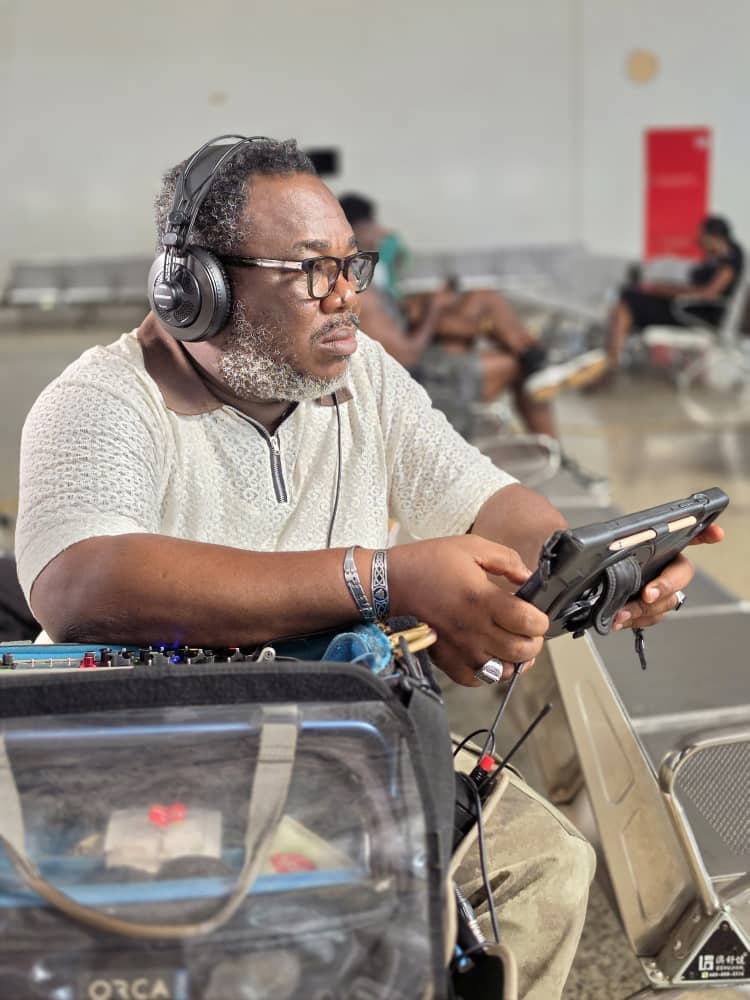
In those days, we lived in a face-to-face apartment. For people who don’t know what that means, it was like a one-bedroom apartment, and there were six of us. We grew up with our mum and dad. We were happy, but we were also struggling to balance life.
In those days, you know how NEPA would take the light and bring it back. Every weekend, when my dad was at home, especially when there was no electricity, he would give us that kind of vibe through music. Sometimes around four or five in the morning, he would start with very cool music. At that time, we didn’t know what it was called. Later, as I grew older, I found out that it was blues and other kinds of music.
As time went on, the tone of the music would change. It was almost like a signal that everybody should wake up. It started solemnly and continued until the time when the light would go off again. I think my dad got me involved in all those things.
I would go back to the vinyl records because I wanted to know how they were performing. I wanted to understand what was happening. Sometimes I would think something was happening live, only to realise later that it had already been recorded and was simply being played back.
So, my father got me involved in all those things, and it made me happy. Growing up around the church and around musicians also gave me the enthusiasm to say, “I still want to know more about sound and television.”
Akam: Before we move on, you mentioned growing up with your parents and siblings. What was that experience like for you?
Fatoke: I was always the kind of boy who wanted to help. When I was growing up, I used to help my mother. My late sister was the first child, and I was the second. My parents made sure we learned different things. I learned how to cook, and I can cook very well. All those things prepared me. When you are growing up, you may think some of the things your parents make you do are punishment. But they are not necessarily punishment. Later, I realised that they were teaching me how to face life.
Akam: You eventually went to the Polytechnic. What were you studying?
Fatoke: I wanted to study Mass Communication because I wanted to be around cameras and everything else involved in Mass Communication. Unfortunately, when I was in school, cultism became an issue. People wanted me to join a cult. I didn’t join any of those things, but I still wanted to focus on how to achieve my aim. I was also doing the programme part-time, and I was basically sending myself to school. Eventually, I decided to stop and pursue the things I needed for myself elsewhere.
Akam: So, were you threatened by the cultists at the Polytechnic, and was leaving your way of protecting yourself?
Fatoke: Yes, that’s it. I left peacefully to protect myself because I didn’t want to join them, and I didn’t want to be part of that kind of group. If I chose to stay, it was either I joined them or something could happen to me. So, I decided to leave.
Akam: Before we get too far into that, let’s return to the beginning of your career. You started out around cameras, didn’t you?
Fatoke: Yes. I started a video-recording job in our area. I began learning how to become a cameraman and started operating VHS cameras in those days. But then I thought, “Everybody wants to become a cameraman. Why do I need to become what everybody wants to become?”
I had an opportunity to work with one of the movie directors, who was also a brother and a boss to me, Yemi Amodu. One day, I was invited to a location, and I saw that everybody wanted to become either an actor, producer, director or cameraman. Nobody wanted to do sound. Nobody wanted to do lighting.
I asked myself, “Why is nobody putting all these things in shape?” There was also very little use of computers at the time. So I said, “You know what? I think I would love to do sound. Since I have this sound background in my life, I want to do sound.”
That was why I picked up a microphone one day. I started setting it up. Whether it was good or bad, I started listening to it. When it was distorted, I would know: “This thing is too loud. It doesn’t sound normal.” I started teaching myself. Teaching myself. And here I am today.
Akam: Wow.
Fatoke: It has become a mystery.
Akam: You entered the industry through camera work, but you noticed that there were fewer people in sound. Was that what attracted you to the department?
Fatoke: When I started sound, there was almost nothing in the Nigerian movie industry that was properly identified as sound.
Let me give you a brief background. The camera rental houses would usually give an assistant to follow the camera. Those assistants were there to monitor the boss’s equipment. They might end up doing sound, lighting and other things. The only person the rental company really gave you was somebody to operate the equipment.
When I started, the people who followed the cameras would also want to do sound and lighting. But professionally, you need to hire the people who are actually professionals in those areas. Those guys would sometimes come with bad cables and bad equipment. As a professional, you need to have your own cable that you trust. You need to have proper headphones that you trust so that you can do the job properly.
So, I picked up sound not just because I wanted to do sound, but because I loved doing it. I didn’t want to be everybody’s wagon. I wanted to be my own kind of person—someone people could also learn from and emulate.
That was why I picked up sound at a time when only a few people were doing it. Even among those people who were doing it, many had not actually gone to school to study sound. They had come from filmmaking and then moved into sound. But sound is a very wide profession. Nigeria was just beginning to understand that.
At that time, when Nollywood was still relatively young, I started developing myself in that area. One of the people who had actually gone outside Nigeria to study sound was the late Femi Alaba. He was one of our bosses. He had the opportunity to go to film school in the UK, study sound and specialise in it before returning to Nigeria to practise.
But how many producers could afford to pay someone like Femi Alaba, considering his years of experience and the expertise he had? So, those of us who became sound professionals had to pick it up ourselves and start learning.
Akam: Was your decision to move into sound based on passion or opportunity?
Fatoke: I think my decision to study sound was based on passion. It was not based on opportunity. If it had been based on opportunity, I would have stuck with operating cameras. I had already said to myself, “I want to compete with some of the top DPs here in Nigeria and outside Nigeria.” I had the opportunity to operate cameras, even though it was on a smaller scale. I would have loved to do it on a bigger scale—shooting films, documentaries and other productions.
But passion drove me into sound. That is the only thing. I love it. I love the way I teach myself. I love the way I get to know things that I don’t know and learn them on my own. The same way I interpret problems and look for solutions is the same way I approach sound. People may use different words or expressions for the same thing, but the meaning remains the same.
It is passion that drove me to become a sound recordist. Not opportunity.
Akam: Thank you so much.
Fatoke: You’re welcome.
To be continued…