She spoke with the certainty of a woman who had made up her mind.
In a video that spread across the continent within hours of appearing on South African social media in late April 2026, a South African woman made a sweeping claim: that Nigerians are responsible for 60 percent of crime in South Africa. She urged fellow South African women married to Nigerian men to pack their bags and leave. “If a man loves you,” she declared, “he must take you back to where he’s coming from.”
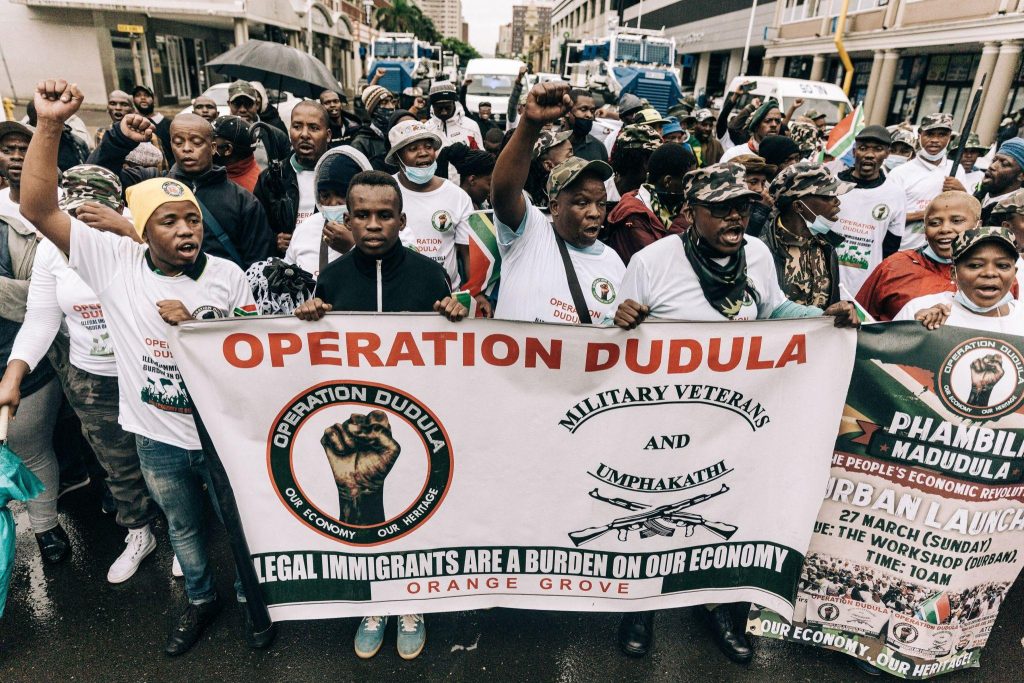
The video did not emerge in a vacuum. It surfaced in the same week that thousands marched through Johannesburg and Tshwane under the banners of March and March and Operation Dudula, demanding the expulsion of undocumented foreigners. It came as the United Nations issued a formal warning to the South African government about rising xenophobic violence, and as Nigerian and Ghanaian diplomatic missions advised their nationals to exercise extreme caution.
For many South Africans, the woman was stating what they believe to be true. For the data, she was expressing a prejudice dressed up as fact.
The “60 percent figure” has a traceable origin — and it does not come from Nigerian crime data. It stems from a statement by a Gauteng SAPS Provincial Commissioner, who said approximately 60 percent of suspects arrested for violent crimes in Gauteng were illegal immigrants. Not Nigerians — illegal immigrants, a category dominated in South Africa by Zimbabweans and Mozambicans, who share a land border and cross in large numbers annually.
SAPS does not publicly release data on the nationalities of those it arrests. More critically, SAPS identifies perpetrators in only 23.9 percent of murders and 17.9 percent of aggravated robberies. This means that in over 80 percent of the country’s most violent crimes, police do not know who the perpetrators are. A claim of “60 percent Nigerians” in this context is not a statistic — it is speculation, or worse, deliberate misdirection.
Data from the World Prison Brief and South Africa’s Department of Correctional Services clarifies the picture. South Africans make up 89.5 percent of the prison population, while foreign nationals account for just 10.5 percent. Among those foreign nationals, Zimbabweans form the largest group — not Nigerians. Zimbabwe accounts for 591 foreign offenders, Mozambique 330, and Nigeria 245.
The woman in the video has redirected real frustration toward the most visible foreign community in the country. This is psychologically understandable. It is statistically false.
To understand how South Africa arrived at this moment, one must look at a society that achieved a peaceful democratic transition in 1994 and then steadily squandered that inheritance. Today, South Africa is the most unequal country in the world by Gini coefficient. The official unemployment rate stands at 32.9 percent, with 8.2 million unemployed, 3.5 million discouraged work-seekers, and nearly 25 million working-age citizens with no income. Youth unemployment has risen to 46.1 percent. More than half the population lives below the poverty line.
This is not a temporary shock. It is a generational failure — two decades of declining education quality, deindustrialisation, and state capture that successive governments have failed to confront honestly.
Within this pressure cooker, xenophobia provides a convenient outlet. Foreign nationals become the explanation for everything: unemployment, crime, drugs, and housing shortages. Distrust of African immigrants among South Africans rose from 62.6 percent in 2021 to 73.1 percent in 2025, tracking closely with the rise of organised anti-immigrant movements.
There is a bitter irony here. Nigeria was among the most vocal and generous supporters of the ANC during the anti-apartheid struggle, contributing funds, diplomatic pressure, and moral support. Today, many Nigerians argue that South Africa has not shown gratitude for that support. Based on current realities, that claim is difficult to dismiss.
A second viral video added another dimension to the debate. In it, a South African citizen demands that the government give every citizen one million rand as a guaranteed lifetime income. The argument is simple: the country has resources, so the state should distribute them.
South Africa’s National Treasury rejected this proposal in 2024, estimating it would cost R400 billion annually and foster dependency without addressing unemployment.
This raises an uncomfortable question: if productive foreign nationals are expelled, who will help build the economy needed to sustain such a system?
In many cases, the very foreign nationals being targeted are creating economic activity, taking risks, and providing services in areas the state has neglected. Expelling them does not create jobs — it destroys existing ones.
Crime statistics also contradict the prevailing narrative. According to the Numbeo Crime Index 2025, South Africa ranks highest in Africa with a score of 74.7, while Nigeria ranks second at 66.6. Nigeria’s murder rate is roughly 22 per 100,000 people, less than half of South Africa’s 45 per 100,000. Despite having nearly four times the population, Nigeria records a comparable or lower number of total murders annually.
A 2025 peer-reviewed study of 40 incarcerated foreign nationals across four South African correctional centres further reinforces this pattern: Mozambique (14), Zimbabwe (6), Nigeria (5), Lesotho (4), with smaller numbers from other countries. The data is consistent — Nigerians are not the primary contributors to crime.
If South Africa seeks answers, it must look inward.
Inequality, unemployment, illegal firearms, institutional breakdown, and political failure are the true drivers of crime. A justice system solving fewer than one in four murders, rising mob violence, and decades of governance failures have created the current crisis. No immigrant group is responsible for this.
The solutions are clear: invest in education, rebuild policing and justice institutions, pursue real economic reform, and address regional arms trafficking. Most importantly, citizens must hold leaders accountable instead of blaming outsiders.
South Africa was meant to be a model — proof that reconciliation and democracy could deliver progress. When it turns against foreign nationals, it sends a troubling message across the continent.
The woman in the video deserves empathy. Her fear is real. Her frustration is valid. But her conclusion is wrong.
South Africa’s crisis will not be solved by blaming immigrants. It will be solved by confronting the truth.
And that begins by looking inward — not outward.
For comments, reflections, and further conversation:
Email: samuelagogo4one@yahoo.com
Phone: +2348055847364