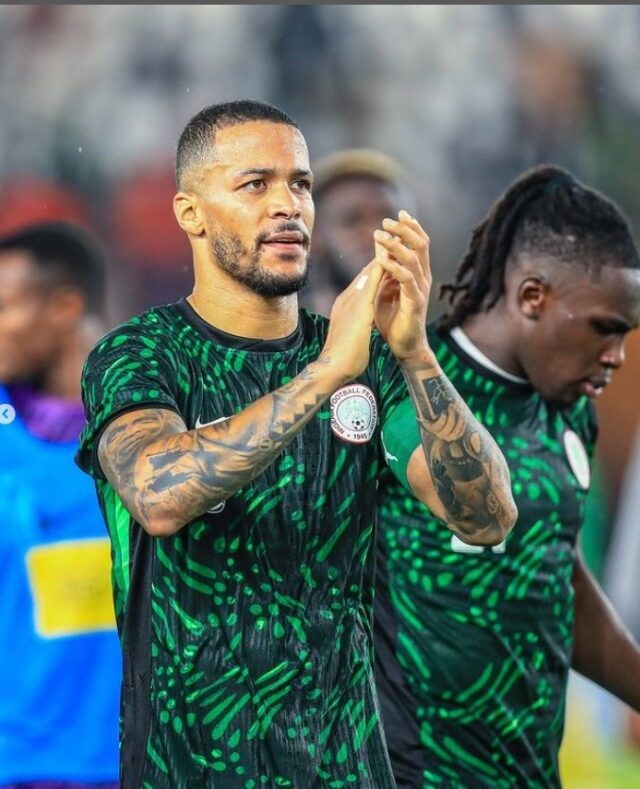
Few players have worn the Super Eagles badge with more heart and honour than William Troost-Ekong. But as the veteran defender bids farewell to international football, it is the World Cup that got away that tells the truest story of his remarkable career.
When William Troost-Ekong made his Super Eagles debut in 2015 against Chad, few could have predicted that a Dutch-born defender from Haarlem would become one of the most decorated and beloved captains in Nigerian football history. A decade later, on December 4, 2025, he brought that journey to a close — 83 caps, five major tournaments, and an AFCON Player of the Tournament award. Yet for all the glory, it is the one dream that never came true — a second World Cup appearance — that casts the longest shadow. Nigeria’s heartbreaking playoff defeat to DR Congo in Rabat was his final appearance in green and white, and, he has since admitted, the pain of that exit was very real.
The footballer was born on September 1, 1993, in Haarlem, Netherlands, to a Nigerian father, Paul Ekong, and a Dutch mother. He hails from Etinan in Akwa Ibom State, Nigeria. While the name William Troost-Ekong combines his Dutch mother’s surname (Troost) with his father’s surname (Ekong), it is his father’s Nigerian heritage that the Super Eagles captain represents on the international stage — a key part of his identity as a footballer. Long before the captain’s armband, Troost-Ekong’s journey began with his father’s bold decision to send his 12-year-old son from the Netherlands to Hockerill Anglo-European College in England to build character. The early days were lonely but transformative, and it was in the youth academies of Fulham and Tottenham Hotspur that the making of a future Super Eagles captain truly began.
From there, the journey gathered unstoppable momentum. After weathering spells at Gent, Bursaspor, and FK Haugesund, he earned a move to Serie A with Udinese in 2018 and then to the Premier League with Watford, where he and Leon Balogun formed the legendary “Oyibo Wall” — a defensive partnership that became the bedrock of Nigeria’s defence for years. A year later, he was part of the U-23 squad that claimed Olympic bronze in Rio de Janeiro. He featured at the 2018 World Cup in Russia and delivered AFCON bronze in 2019 and silver in 2023. But it was the 2023 AFCON in Côte d’Ivoire that truly defined his legacy — scoring three crucial goals, captaining Nigeria to the final, smashing in a penalty under immense pressure, and being named Player of the Tournament, the first defender to claim the honour in over two decades. With five career AFCON goals, he became the highest-scoring defender in the tournament’s history — 83 caps, a lifetime of service, and a legacy carved in green and white.
The AFCON silver was beautiful, but the World Cup absence was devastating for the player and Nigerians at large. Considering his age, another World Cup would have possibly been his last major stage. Nigeria’s failure to qualify for the 2026 World Cup was a sign that the end of the road for national duty had come for the footballer. His final appearance for the Super Eagles was a start in the 2-1 victory over Lesotho. He was named in the squad for the subsequent 4-0 win against Rwanda but was an unused substitute in that match. Troost-Ekong was also an unused substitute in both playoff matches against Gabon and the Democratic Republic of Congo, as Nigeria made one final attempt to secure World Cup qualification after finishing as runners-up in their group.
After the 4-3 penalty shootout loss to DR Congo in the final of the African play-offs held in Rabat, Morocco, he admitted that the Super Eagles were under pressure to qualify for the 2026 FIFA World Cup. The captain encouraged the team when he told Pooja Media: “I think the boys stepped up. It happens. They will learn so much from this moment, and I’m sure when the next opportunity comes, they will be better prepared to make a difference.”
The retirement decision came as a shock after Nigeria’s inability to qualify for the World Cup. Speaking on Sky Sports, the former Watford defender said the choice was driven by family considerations and the need to realign his goals.
“I think sometimes you have to look at the bigger picture and know the circumstances change,” he said. “I have a young family, and I have sacrificed a lot, time-wise, also injuries, traveling — things that are all part of being an international football player, which I love doing, and I wouldn’t change that for anything. But there comes a time when you have to weigh up all those things and understand where your priority is, and I think if you can’t commit to that one hundred percent, then it’s time to pass the baton on.”
He also said his decision to retire was to give younger players an opportunity for more playing time. Troost-Ekong said, “I think Eric Chelle, the coach they have now, has done a fantastic job turning around a very difficult start because it was an uphill race the moment he took the job over a year ago. I retired from international football. It was the World Cup that I wanted to be a part of and a great chance to show myself there, but you have to think about what’s best for the country and the next generation. This might be one of the moments we talked about,” per the NY Times.
The World Cup is the peak of every football career. Taking part in the World Cup and delivering a good performance is a source of pride for the player, the team, and the country, as it puts your name on the walls of history. This is a stage where you meet the best of the best and shake hands with the legends of the game. Aside from the gratification that comes with progression from any stage, it presents you to the world. But on the fading away of this dream, William Troost-Ekong decided to draw the curtain down immediately without hesitation, putting his family and his younger teammates into consideration.
The World Cup dream never came. But everything else did: 83 caps, an Olympic medal, AFCON glory, a Player of the Tournament award, and the undying love of a nation he chose to call his own. William Troost-Ekong gave Nigeria a decade of his life as a footballer — his leadership, talent, and quality on the pitch. That is not a career defined by what was missed, but rather a legacy defined by what was given.